


A founder opens the VAT portal and finds three different versions of the same quarter. The invoicing app shows one total, the bank feed shows another, and a spreadsheet contains the figures someone typed after chasing missing receipts. Nothing is wrong with the VAT calculation itself. The problem is that invoices, payments, ledger entries, and returns aren't connected.
That's why accounting for VAT feels harder as an SME grows. VAT is a consumption tax collected through business transactions, with businesses generally charging output VAT on sales and offsetting eligible input VAT on purchases. Its global reach makes accurate systems important. The first recognizable VAT appeared in France in 1948, became a consumption-type VAT by 1954, and VAT is now used in more than 170 countries, according to the IMF's VAT history and development overview.
For an EU business, VAT accounting is best treated as a connected data problem, not a separate tax chore. Zynthoro brings finance, invoicing, payments, and reporting into one AI-native ERP workflow, so each transaction can carry its tax treatment from capture through reconciliation.
Table of Contents
- Why VAT Accounting Feels Harder Than It Should
- Registering for VAT in the EU
- Invoicing Rules Every SME Should Know
- VAT Rates and Reverse Charge Scenarios
- Reclaiming Input VAT and Keeping Books Clean
- Filing Cadences and Recordkeeping Obligations
- Preparing VAT Books for Digital Reporting
- Pulling It All Together with Zynthoro
Why VAT Accounting Feels Harder Than It Should
A three-person design studio in Rotterdam can begin with a simple routine. The founder sends invoices from one application, checks customer payments in a bank tool, and maintains a spreadsheet for quarterly VAT. Supplier bills arrive by email, receipts collect in a shared drive, and the accountant requests VAT identification numbers just before the return is due.
Then the founder retypes sales totals, searches for missing purchase invoices, and compares bank deposits with invoices that may have been partly paid. A credit note can alter the quarter's figures, while a cross-border service may receive different VAT treatment from a local project. The calculation is manageable. Re-entering one transaction across several systems creates the risk.
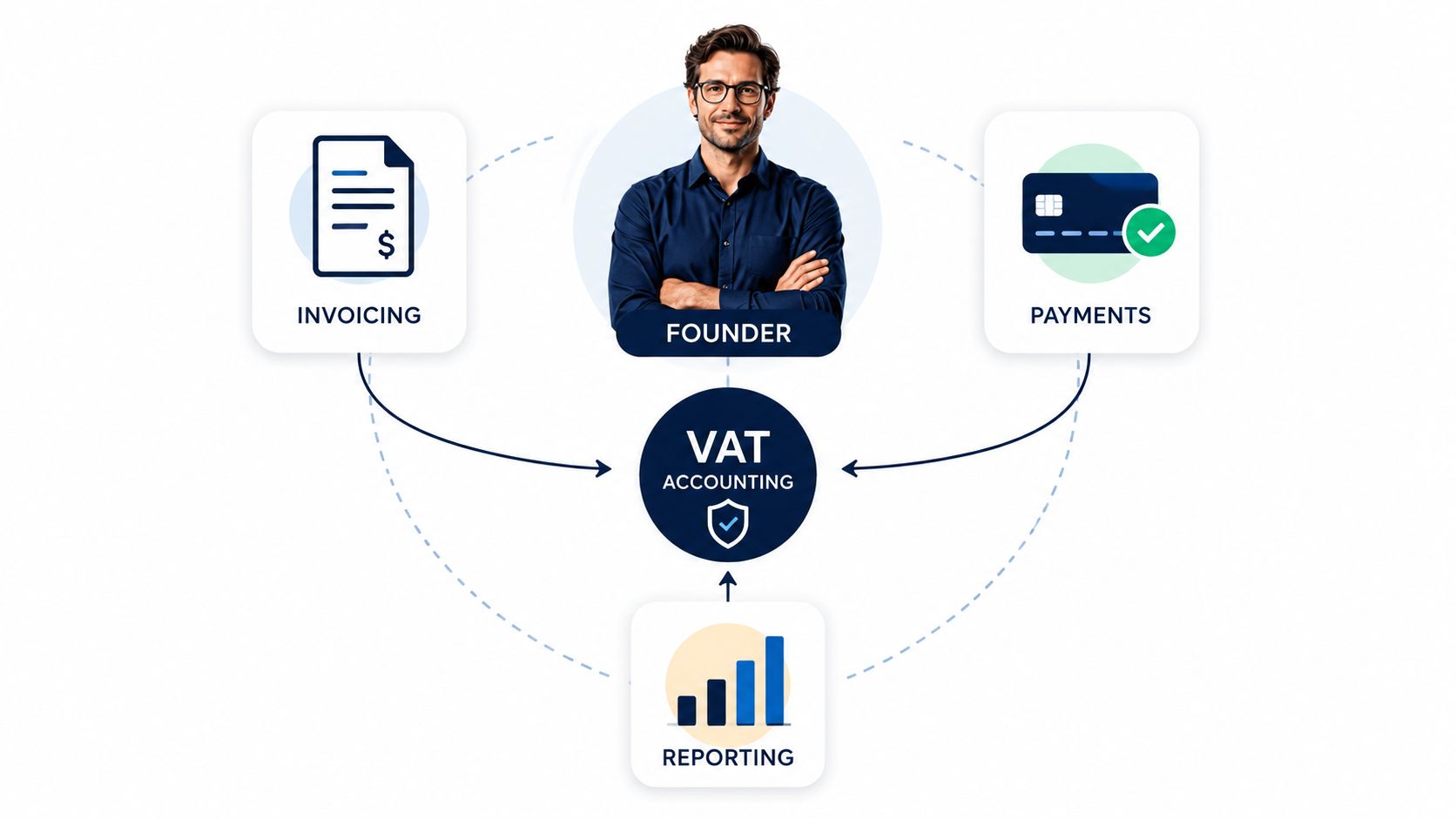
VAT is the thread between three records
A sale creates more than an invoice. It creates a customer balance, an expected payment, a revenue entry, an output VAT entry, and eventually a line in a VAT return. A purchase creates a supplier liability, an expense or asset, an input VAT entry, and a possible reclaim.
The same transaction therefore travels through invoicing, payments, accounting, and reporting. If those records do not share a transaction ID, tax code, customer data, and payment status, reconciliation becomes detective work. A connected workflow keeps the commercial document and its accounting treatment together.
Practical rule: If a transaction changes in the invoicing system, the ledger and reporting view should reflect that change without another person retyping it.
Zynthoro brings finance, invoicing, payments, and reporting into one AI-native ERP workflow. Each transaction can carry its tax treatment from capture through reconciliation, so VAT accounting follows the business activity instead of sitting apart from it.
Registrations, VAT rates, exemptions, reverse charges, credits, and filing deadlines can become structured fields and workflow conditions. That gives a team a clearer way to apply changing rules than isolated spreadsheet notes.
The European Union's VAT compliance gap was estimated at €128 billion in 2023, equal to 9.5% of total VAT liability, according to the European Commission's VAT gap analysis. The figures concern public collections, not an individual SME's books. They still show why tax authorities place greater emphasis on complete, consistent transaction data.
Registering for VAT in the EU
VAT registration starts with the country where your business is established, but it doesn't end there. Each EU member state has its own domestic rules, and cross-border sales can create separate reporting duties even when your home-country turnover looks modest.
A practical registration review should answer four questions:
- Where is the business established? Start with the domestic VAT rules of that member state.
- What is being sold? Goods, services, B2B supplies, and B2C sales can follow different place-of-supply rules.
- Who is the customer? A business customer with a valid VAT ID may receive a reverse-charge treatment, while a consumer sale can create destination-country obligations.
- Which simplification applies? OSS and the EU small-enterprise scheme can change how a business reports qualifying activity.
The EU small-enterprise rules require careful threshold tracking. A business with total annual turnover across the 27 member states not exceeding €100,000 can apply for the cross-border SME simplification, while domestic exemption thresholds remain set separately by individual countries. The EU small-enterprise VAT scheme explains why one domestic exemption doesn't automatically answer every cross-border question.
Consider a consultancy with €92,000 of turnover in one member state and smaller sales into two others. It may remain below a domestic exemption threshold, yet still needs to monitor its combined EU turnover against the cross-border cap. A VAT-aware accounting system should track the country, customer type, transaction value, registration status, and scheme conditions together.
| Trigger | Typical Threshold | Where to Register |
|---|---|---|
| Domestic taxable turnover | Set by the member state | Usually the business's home member state |
| Cross-border SME simplification | €100,000 across the EU | Member states covered by the scheme, subject to eligibility |
| Cross-border B2C activity | Depends on the applicable rules | Often through OSS or the customer's member state |
| Cross-border B2B services | Often governed by place-of-supply rules | Reverse charge may apply instead of local registration |
Don't treat the table as a substitute for checking the specific country rule. Registration status should live in your customer and company master data, not only in an accountant's email.
Invoicing Rules Every SME Should Know
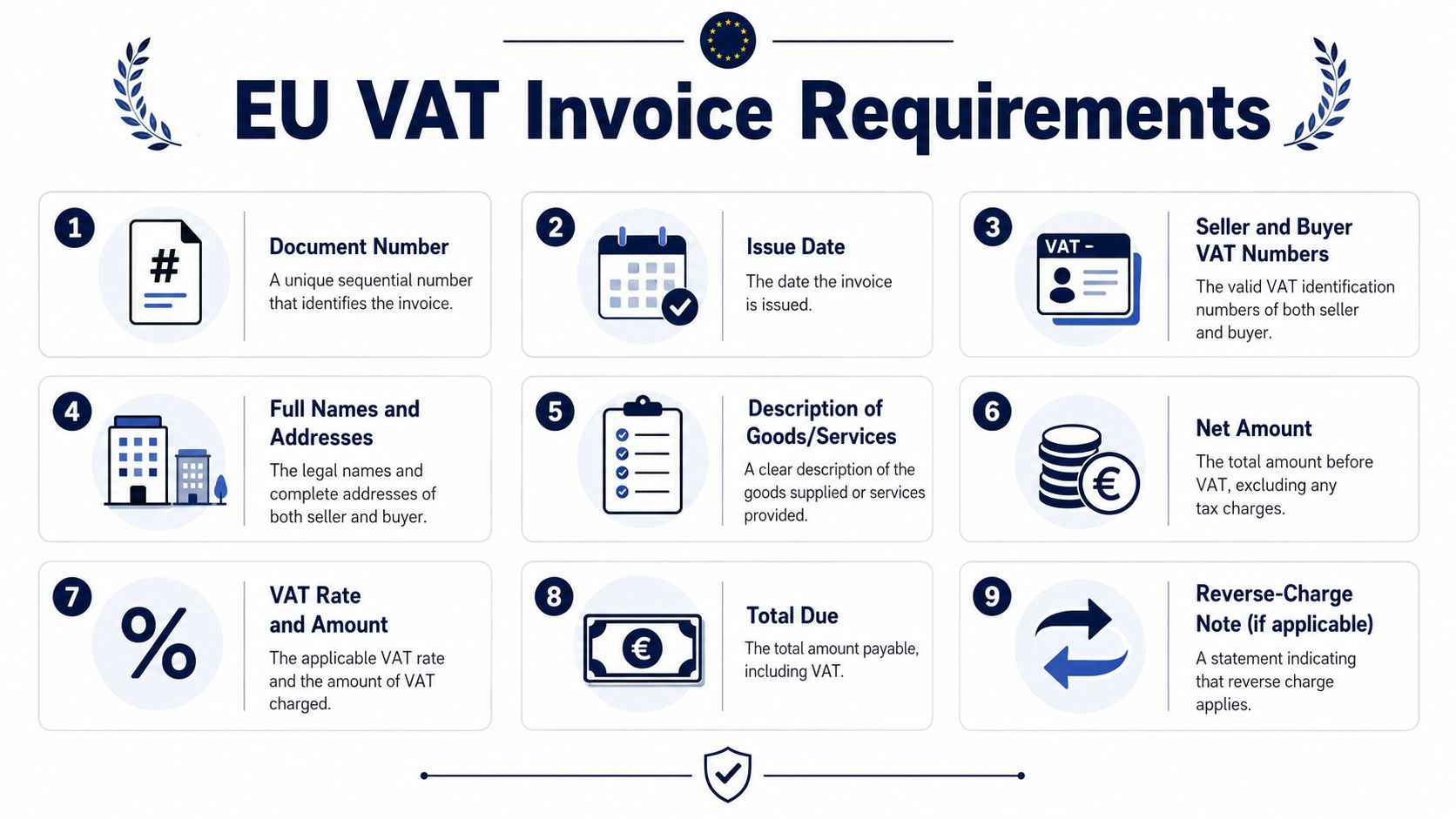
A compliant VAT invoice gives the buyer and tax authority enough information to identify the transaction, the parties, and the tax treatment. In practice, that means keeping the invoice sequence intact and capturing the supplier and customer details in structured fields.
The core fields include:
- Invoice identity: A sequential invoice number and issue date.
- Party details: Supplier and customer names, addresses, and VAT identification numbers.
- Supply description: A clear description of the goods or services, with quantity or scope where relevant.
- Tax calculation: Net amount, applicable VAT rate, VAT amount in euros, and total due.
- Special treatment: A clear reverse-charge statement when the buyer is responsible for accounting for VAT.
For EU reverse-charge supplies, the seller generally issues the invoice without charging VAT and includes the words “reverse charge.” The buyer then self-accounts for the tax. The invoice still needs the ordinary trade details and VAT identifiers, so reverse charge isn't a reason to issue a simplified or incomplete document. The EU reverse-charge invoice requirements guide provides a useful field-by-field reference.
A Polish design agency bills a French business customer €5,000 for qualifying B2B design services. The agency records the sale without Polish VAT, shows the Polish and French VAT IDs with their country prefixes, and adds a clear reverse-charge note. The French customer accounts for the relevant VAT in its own return.
The software should validate those fields before the invoice is sent. If the customer VAT ID is missing, the reverse-charge rule shouldn't automatically pass as a normal zero-VAT sale. Zynthoro can keep customer setup, invoice generation, ledger posting, and reporting aligned in one workflow.
The following video offers an additional visual explanation of VAT invoice requirements:
VAT Rates and Reverse Charge Scenarios
VAT rates are easier to understand when you separate the rate applied to a domestic supply from the party responsible for accounting for the tax. Standard, reduced, super-reduced, and zero rates describe the tax rate. Reverse charge describes a liability mechanism.
A country can apply a reduced rate to a particular category, but that doesn't mean every cross-border B2B service qualifies for that rate. Member states define which goods and services receive reduced treatment, so a rate library needs both the percentage and the product or service classification. For a current country-by-country reference, consult 2026 VAT rates and compliance from FastCorp.
| Rate Band | Typical Range | Example Countries | Common Goods/Services | Reverse Charge? |
|---|---|---|---|---|
| Standard | Country-specific standard rate | Netherlands 21%, Germany 19% | Most taxable goods and services | May apply to qualifying cross-border B2B supplies |
| Reduced | Below the standard rate | Country-specific categories | Selected goods and services | Depends on the transaction rules |
| Super-reduced | Very low country-specific rate | France 5% on books, Spain 4% on staples | Narrow categories defined by national rules | Depends on the transaction rules |
| Zero | 0% | UK groceries can be zero-rated | Specific essentials or exports, where allowed | Not the same as reverse charge |
A Polish design agency provides development work to a German business for €10,000. If the transaction qualifies for the cross-border B2B reverse charge, the Polish supplier invoices without Polish VAT and includes the reverse-charge statement. The German customer self-accounts using the applicable German treatment, which in the scenario is 19% German VAT.
The supplier's books should show the net sale and zero output VAT charged. The buyer's return can show the self-assessed amount as output VAT and, where the purchase is eligible, the corresponding input VAT. That can net to zero, but the transaction still needs correct evidence and posting.
The supplier should retain the customer's valid VAT ID and confirm that the service qualifies. A rate of zero isn't a shortcut around customer verification or invoice compliance.
Reclaiming Input VAT and Keeping Books Clean
Input VAT recovery starts with a clean purchase record. It isn't a separate exercise performed after the accounts are closed. Each expense should enter the ledger with its supplier, date, tax amount, business purpose, and treatment already attached.
Take a small agency with three expenses:
- A €480 coworking fee with a valid local VAT invoice.
- A €1,200 software subscription from a US vendor, where the buyer may need to apply reverse charge rather than expect the supplier to charge local VAT.
- A €250 team lunch, which may face restrictions depending on the country and the nature of the expense.
The coworking invoice can feed an input VAT line if the document and expense qualify. The software purchase needs a self-assessment entry that mirrors the reverse-charge treatment. The lunch requires a policy and jurisdiction check before anyone marks its VAT as deductible.
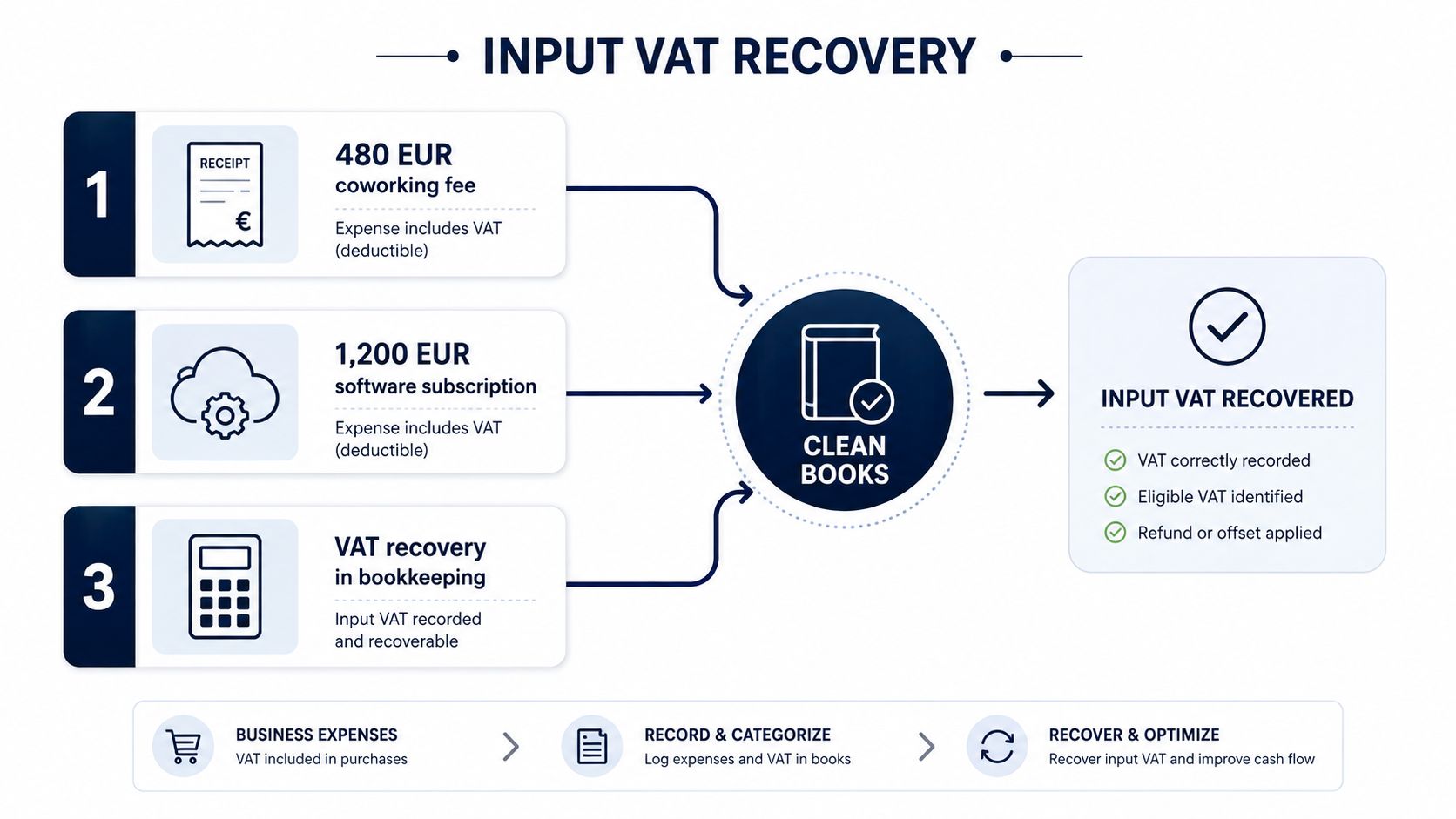
What makes a purchase record usable
A purchase invoice should contain the supplier's VAT number, correct tax breakdown, issue date, business purpose, and the right expense category. Personal use, entertainment restrictions, missing VAT identifiers, and an invoice that doesn't describe the supply can all prevent recovery.
The reconciliation is straightforward:
Output VAT on sales minus deductible input VAT on purchases equals the net VAT payable or refund due.
The difficult part is proving that every line belongs in the calculation. A connected ledger gives the accountant the source invoice, approval history, payment status, and tax code together. Guidance on input VAT rules for limited companies is useful when deciding whether a particular cost can be reclaimed.
An agency team comparing platforms might encounter Agency, listed as a €1,199 per month full non-ERP suite for agencies and multi-client teams, with full accounting and inventory, project management and marketing, five company workspaces, and 25 users. Product scope matters because a system that stores invoices separately from the ledger still leaves the reconciliation problem in place.
Filing Cadences and Recordkeeping Obligations
Two accounting approaches shape the moment VAT enters the return. Under invoice accounting, VAT is generally recognized when the invoice is issued or received. Under cash accounting, eligible businesses account for VAT when customer receipts and supplier payments occur.
Cash accounting can ease liquidity pressure because a business doesn't usually remit output VAT before it has collected the customer's money. In the EU, the cash accounting scheme is designed for that purpose, and the 2024 SME rules raise the optional turnover threshold from EUR 500,000 to EUR 2,000,000 in member states that adopt the higher ceiling, as set out in the EU SME cash accounting explanatory notes.
The UK has its own eligibility limit. A VAT-registered business can use the UK cash accounting scheme when its estimated taxable turnover for the next 12 months is £1.35 million or less, according to HMRC's VAT cash accounting guidance. If an agency invoices £10,000 plus VAT in March and the client pays in May, cash accounting generally moves the output VAT timing to receipt.
| Filing Scheme | Eligibility Threshold | VAT Due Trigger | Typical Filing Frequency | Record Retention |
|---|---|---|---|---|
| Invoice accounting | Subject to local rules | Invoice date or accounting event | Local portal cadence | Keep required records for the applicable national period |
| EU cash accounting | Up to EUR 2,000,000 where adopted | Customer and supplier payment events | Local portal cadence | Keep payment and invoice evidence together |
| UK cash accounting | £1.35 million estimated taxable turnover | Receipt and payment | UK VAT return cadence | Retain records under UK requirements |
| Standard local filing | Set by country and registration status | Local VAT rules | Often periodic | At least six years in the baseline used here, longer in some countries |
A practical quarter-end routine is simple: close the trial balance, reconcile sales and purchase VAT accounts, investigate unmatched invoices and credits, submit through the relevant local or OSS portal, then pay the net liability. Keep invoices, credit notes, import and export documents, returns, and tax correspondence in a searchable format. The baseline is at least six years, with ten years in some countries, while cross-border records can carry different retention expectations.
Preparing VAT Books for Digital Reporting
A spreadsheet may show a VAT total, yet still leave basic questions unanswered. Which invoice created the amount? Has the customer paid? Did the line use the correct rate or reverse-charge treatment? Digital reporting shifts the focus toward records that can be read and reconciled automatically, so invoicing, payments, and reporting need to share the same underlying data.
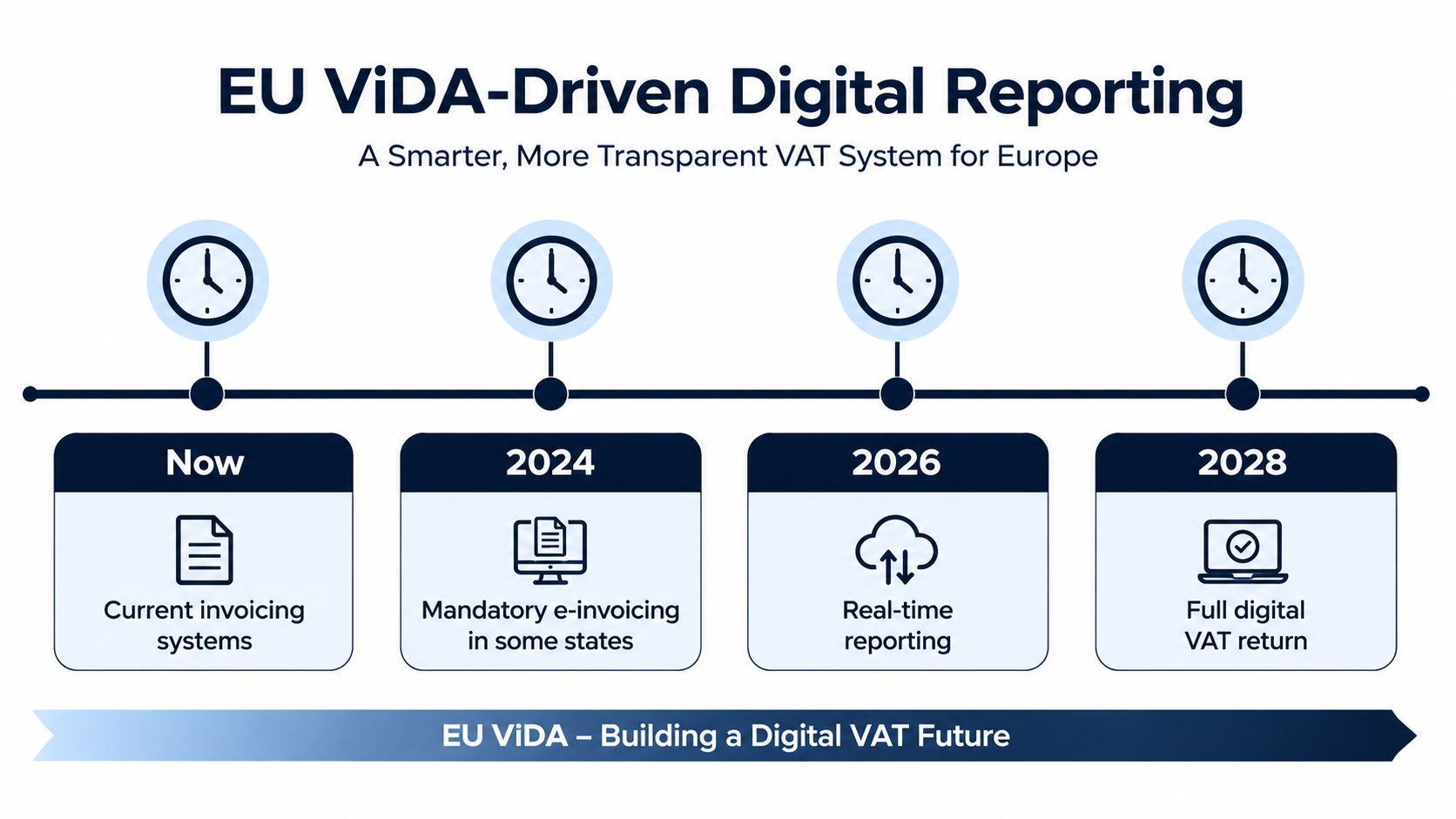
The EU's VAT in the Digital Age package is moving cross-border B2B reporting toward a more immediate digital model. From 1 July 2030, cross-border B2B transactions in the EU are set to face mandatory digital reporting requirements, with e-invoicing as the default invoicing method, according to the European Commission's VAT in the Digital Age overview.
That direction makes hidden spreadsheet gaps easier to spot. A customer record should contain the country, VAT ID, validation status, and B2B or B2C classification. Each invoice line should carry its supply type, rate or exemption code, reverse-charge status, and reporting category. Payments should connect to the invoices they settle, particularly where cash accounting changes the VAT date.
Build the ledger for machine-readable evidence
A practical VAT data model has four connected layers:
- Master data: Company registrations, VAT IDs, countries, customer status, and supplier details.
- Transaction data: Invoice lines, tax codes, dates, currencies, credits, and payment references.
- Accounting data: Output VAT, input VAT, reverse-charge postings, receivables, and payables.
- Reporting data: Return boxes, OSS or local filing categories, submission status, and audit evidence.
Zynthoro's connected finance and invoicing workflow follows this chain. The team can query VAT figures from live ledger data, review exceptions, and retain the supporting document trail instead of rebuilding a quarterly view across separate applications. An AI-native ERP can therefore bring invoice capture, payment matching, accounting entries, and return preparation into one workflow.
The result is a book of accounts that can answer why a tax amount exists, which invoice created it, whether payment has occurred, and how the line reached the return.
Pulling It All Together with Zynthoro
A small EU team consolidating its VAT workflow needs a system that connects registration tracking, rate selection, reverse-charge logic, input VAT recovery, payment timing, and return assembly. These are linked records, not isolated tax tasks. An invoice creates a tax entry, a payment affects its status and sometimes its timing, and the return must explain how both reached the reported figure.
Zynthoro is an AI-native ERP combining accounting, invoicing and finance, sales administration, purchase administration, and reporting in one EU-hosted workspace. An invoice can be captured, classified, checked for required fields, posted to the ledger, matched to payment activity, and included in a return draft without retyping totals into a spreadsheet.
AI can surface exceptions, while the business and its advisers retain responsibility for accounting policy. The setup should flag a missing VAT ID, a customer-country mismatch, an unexpected tax code, a reverse-charge sale without the required wording, or an input VAT claim without supporting documents.
A practical consolidation checklist
Start with the company profile. Record each registration, applicable scheme, filing portal, and country-specific deadline. Then configure the transaction rules:
- Map rates by country and supply type: Keep standard, reduced, zero, and exempt treatments separate.
- Validate customer and supplier data: Require VAT IDs and country information before posting cross-border transactions.
- Automate reverse-charge routing: Send qualifying entries to the correct sales and tax-ledger treatment.
- Reconcile payments continuously: Link invoice status to payment activity so cash-based timing remains visible.
- Preserve the audit trail: Store invoices, approvals, credits, adjustments, and return support with each ledger entry.
A 30-day transition can begin with a VAT data review, master-data cleanup, tax-code configuration, invoice-template testing, and a controlled filing-cycle comparison. Test a local sale, a cross-border B2B service, a supplier purchase, a credit note, and a paid invoice. Confirm that each produces the expected invoice, ledger, payment, and reporting result.
For teams exploring a smaller entry point, Kickstarter is listed as Kickstart 1, priced at €79 one-time, with lifetime access, AI Assistants, 50 credits per month, Planning & Time Tracking, the Communication module, and Canva Studio.
Zynthoro gives EU SMEs one connected place for invoicing, payments, ledger entries, VAT treatment, and reporting. Review your registrations, VAT codes, and unresolved invoice exceptions, then visit Zynthoro to see how an AI-native ERP can support cleaner VAT books.