


Monday morning starts with reconciliation. A 40-person manufacturing business owner checks inventory in a spreadsheet, searches for unpaid invoices in an accounting SaaS, opens the CRM to review opportunities, then copies delivery estimates from a logistics portal into customer emails. The work feels routine, but every handoff creates another opportunity for stale data, duplicate entry, or a missed exception.
That's the practical problem AI ERP is meant to solve. Not by adding another chatbot to the software stack, but by bringing finance, sales, purchasing, production, people, and customer workflows into one connected operating environment. For SMEs replacing fragmented tools, the difficult questions are less glamorous than an AI demo: Is the data clean enough? Can the business explain an automated recommendation? Will the system support an audit?
Zynthoro addresses that architecture through an EU-hosted, single-source-of-truth workspace with connected business modules and embedded AI assistants. The value depends on how well the platform fits the company's real processes, so the discussion below focuses on what works, what fails, and where AI ERP should remain under human control.
Table of Contents
- The Fragmented Tool Problem Facing Modern SMEs
- What AI-Native ERP Actually Means
- Core Capabilities That Define AI ERP
- Measurable Benefits for Small and Medium Businesses
- Data Readiness and EU Compliance Considerations
- Zynthoro Versus Traditional ERP Approaches
- Your AI ERP Adoption Checklist
The Fragmented Tool Problem Facing Modern SMEs
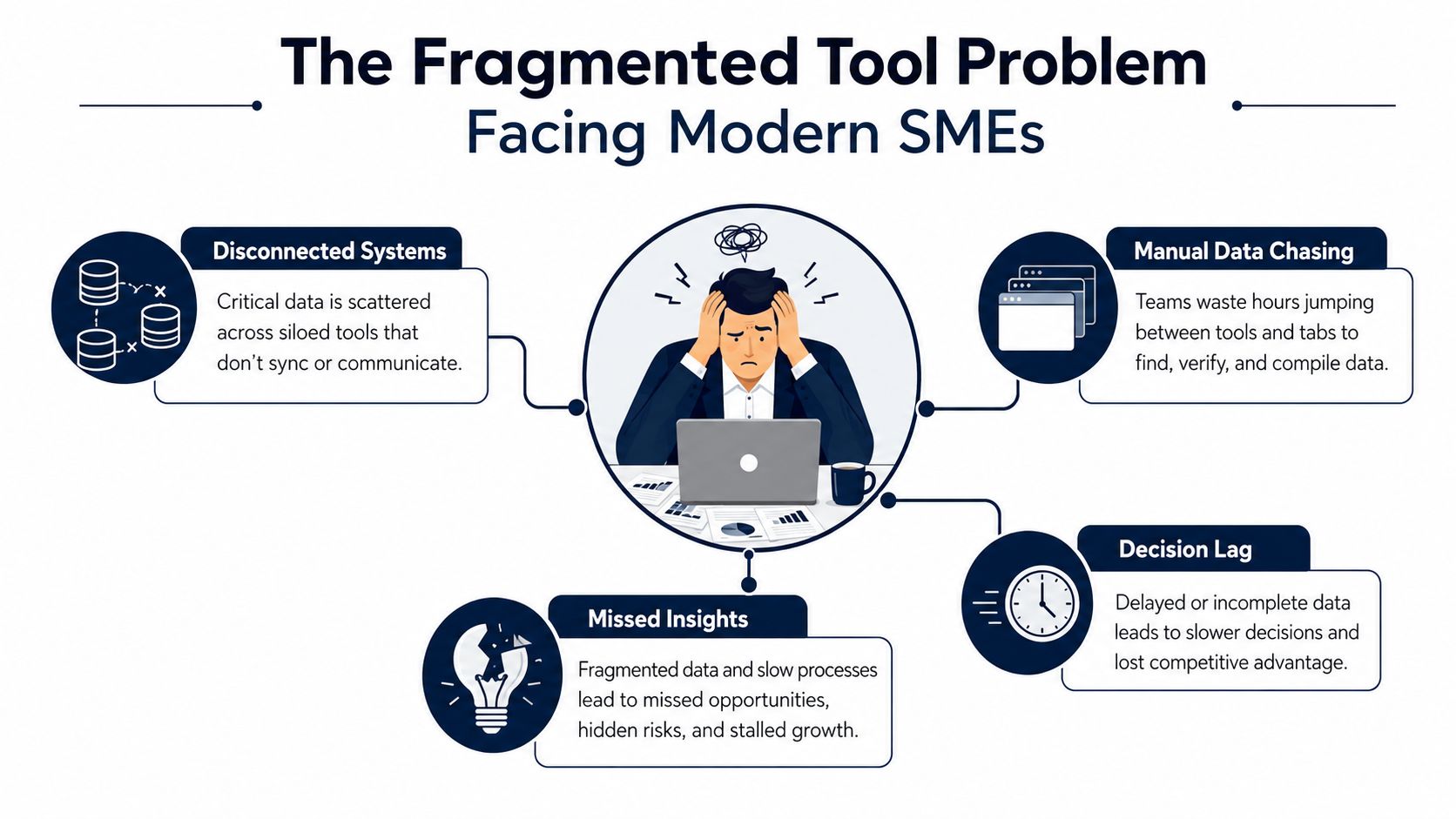
The owner in that Monday scenario usually isn't dealing with one broken application. Each tool may work reasonably well on its own. The accounting system records invoices, the CRM tracks opportunities, the warehouse spreadsheet contains stock counts, and the logistics portal provides transport updates.
The trouble begins between those systems. Employees retype customer details, copy order information, reconcile different product codes, and decide which version of a report is current. A customer may receive an outdated delivery estimate because the person writing the email can't see the latest warehouse status without checking another system.
This is tool sprawl debt. One new subscription solves a local problem, but it often creates integration gaps elsewhere. A separate CRM may not share payment status with sales. An inventory application may not know the production schedule. A project tool may track labor without connecting that time to invoicing or profitability.
The hidden tax of disconnected work
The visible cost is subscription spend. The larger operational cost is the context-switching tax paid by every employee who moves between tabs, exports files, and checks whether two records refer to the same customer or order.
Disconnected tools also make reporting historical by accident. A finance manager might produce a cash position from one system, while the sales team relies on a pipeline report that excludes recent invoices and support issues. Leaders then make decisions on yesterday's numbers, even when the business changes during the day.
Practical rule: If an employee must export, clean, and re-upload data before a routine decision, the business has an architecture problem, not merely a reporting problem.
An AI system can't fix missing context by producing more polished text. It needs access to consistent records, permissions, transaction history, and workflow status. That's why the distinction between an all-in-one AI platform and a collection of specialized applications matters. This comparison of AI platform vs multiple tools is useful when mapping the trade-off between local specialization and shared operational context.
An AI-native ERP offers a different starting point. In Zynthoro, connected modules can keep finance, sales, purchasing, operations, HR, communication, and production information within a shared data model. The promise isn't that every process becomes automatic. The promise is that an assistant can reason over the records that already govern the business, rather than trying to reconstruct context from disconnected exports.
What AI-Native ERP Actually Means
AI-native ERP describes an architecture where AI is built into the platform's data and workflow layer. It doesn't mean that an ERP vendor has added a chatbot, a forecasting screen, or an external language model.
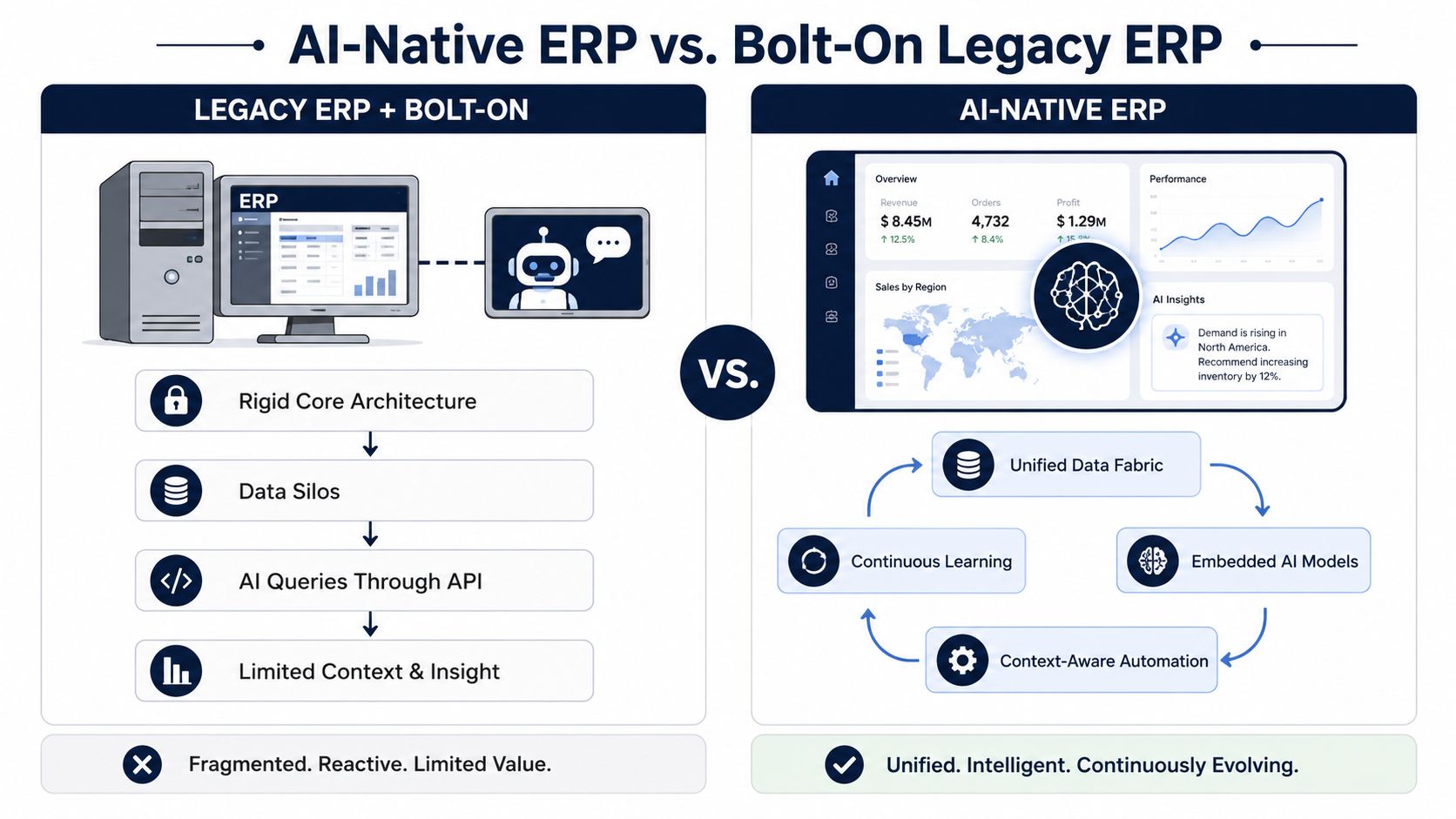
A bolt-on model usually looks like this:
- The ERP stores transactions in its core database.
- An external service requests selected data through APIs.
- The AI generates an answer from that extract.
- A person or automation sends the result back into the ERP.
That arrangement can be useful for narrow tasks, but it introduces points of failure. The extract may be delayed, the API may omit relevant fields, and the assistant may not understand the transaction state, user permissions, or exceptions that a finance or operations employee sees inside the ERP.
The AI-native model puts the assistant closer to the live business process. It can read the same governed records that support invoicing, inventory, sales, purchasing, and people workflows, then recommend or initiate an action within the permissions defined by the platform.
The photocopy and the in-house analyst
A bolt-on assistant is like a translator who receives a folder of photocopies after the meeting. The translator may produce fluent language, but missing pages and outdated versions limit the result.
An embedded assistant is closer to an in-house analyst who sits in the meeting, sees the relevant records, understands the surrounding workflow, and knows which action the user is authorized to take. Zynthoro's embedded Claude assistants illustrate this approach. A sales representative could ask which overdue accounts deserve attention and receive an answer based on payment history, open support matters, and current stock availability, provided those records are maintained in the connected platform.
That doesn't make AI infallible. AI-native does not mean AI-only. Deterministic rules should still govern tax calculations, approval limits, payroll controls, inventory movements, and other actions where repeatability matters. AI is most useful for interpreting information, drafting work, identifying patterns, prioritizing exceptions, and helping a person move through a complex process.
A small team evaluating entry-level functionality can also review Kickstarter, listed with AI Assistants, 50 credits per month, Planning & Time Tracking, Communication module, and Canva Studio for a one-time €79.
The important test is practical: can the system explain where an answer came from, show the records it used, respect permissions, and let a person approve sensitive actions? If not, the presence of generative AI is mostly a surface feature.
Core Capabilities That Define AI ERP
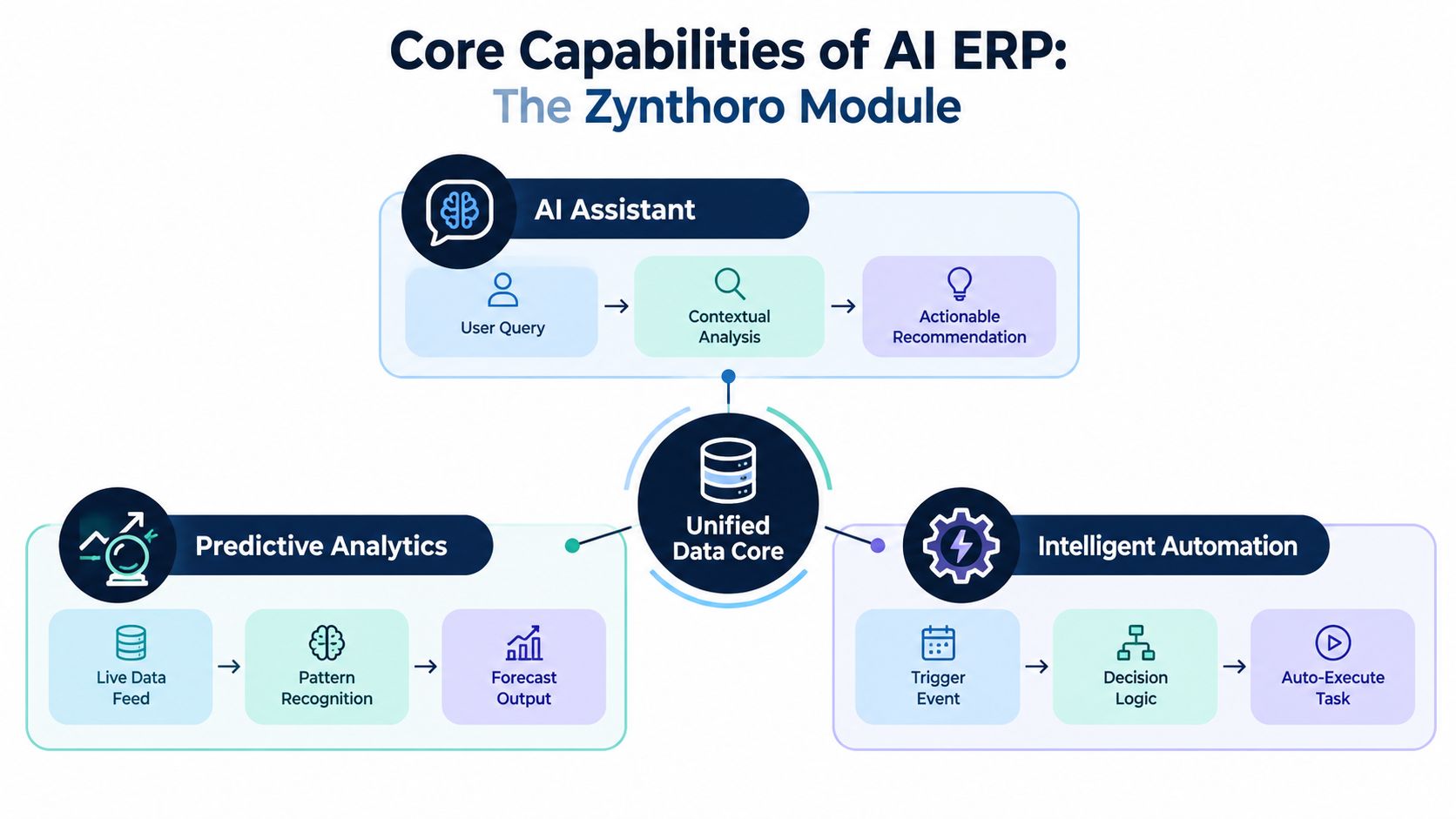
An AI ERP becomes useful when three capabilities operate together: embedded assistance, real-time data continuity, and cross-domain workflow automation. Remove any one of them and the result starts to resemble a dashboard or a collection of integrations.
Embedded assistance inside the workflow
A context-aware assistant should sit where work happens. In purchasing, it might draft a supplier order from an approved requirement. In finance, it could help identify an unusual expense or prepare an explanation for a reconciliation exception. In operations, it may summarize process status and identify the next unresolved handoff.
The test is whether the assistant can use the module's actual records and permissions. A generic chatbot that explains how purchase orders work is less valuable than one that can identify which approved request is waiting for action, show the supplier history, and prepare a draft without forcing the employee into another application.
One transaction, connected consequences
Real-time continuity means a change in one area affects the relevant views elsewhere without a manual batch export. A posted journal entry should be available to the financial view, relevant cash planning, inventory valuation, and project profitability calculations according to the platform's accounting logic.
A normalized data model matters. If “customer,” “product,” “order,” and “supplier” mean different things in different applications, the AI spends its effort resolving identities instead of helping the operator.
Automation across the handoffs
Consider a confirmed sales order. A connected workflow can create a warehouse pick list, prepare shipping information, schedule the relevant carrier task, update the customer portal, and pass the transaction to the appropriate finance process. The assistant can monitor the chain, surface a missing address or stock exception, and ask for approval rather than automatically guessing.
That distinction matters in manufacturing and distribution. A production or delivery process rarely fails at the first step. It fails at the handoff between sales, purchasing, inventory, quality, logistics, and finance. An AI assistant with cross-domain context can help an employee find the break faster, while deterministic controls prevent unauthorized changes.
These capabilities compound as the SME activates more connected modules. The system has more legitimate context, but that context only creates value when ownership, permissions, and data definitions remain clear.
For teams that need finance and sales connected to the earlier planning features, Kickstarter 2 lists Everything in K1, 150 credits per month, Finance & Invoicing, Sales module, and AI photo/video suite for a one-time €149.
Measurable Benefits for Small and Medium Businesses
The business case for AI ERP appears in routine work. Fewer records need to be re-entered, fewer exceptions require manual investigation, and finance and operations spend less time reconciling conflicting information. The value depends on whether the platform connects the relevant workflows and gives staff reliable data to review.
Independent ERP automation research reports a 31.6% improvement in data accuracy compared with traditional automation. It attributes the operational effect to AI-assisted extraction, validation, and routing across processes such as finance, purchasing, and order-to-cash. Those gains still require defined records, approval rules, and human review for uncertain cases.
For an SME, the workflow may extract an invoice once, check it against purchase information, route it to the correct approver, and retain a traceable history. The same connected records can flag a stock discrepancy while an order remains open, before a customer is promised an unavailable item. This reduces correction work without handing final decisions to an assistant.
Where the payoff usually appears
The strongest returns tend to come from repeated searches, duplicate entry, and delayed exception handling:
- Finance administration: Staff spend less time matching invoices, payments, and customer records across separate systems.
- Inventory control: Purchasing, warehouse, and sales employees work from shared product and order context rather than competing files.
- Customer follow-up: Sales teams can prioritize accounts using payment, support, order, and pipeline information together.
- Management reporting: Owners can trace a figure to connected transactions instead of waiting for a manually assembled report.
Market forecasts show why vendors and buyers are investing in these capabilities. According to the Market.us AI in ERP market estimate, the global AI in ERP market was valued at USD 4.5 billion in 2023 and is projected to reach USD 46.5 billion by 2033, with a 26.3% CAGR over 2024 to 2033. The report places North America at 38.4% of the market in 2023, equal to USD 1.72 billion. A separate AI-integrated ERP forecast projects growth from USD 8.38 billion in 2026 to USD 25.13 billion by 2031, at a 24.56% CAGR.
These market figures describe vendor opportunity, not a guaranteed SME return. Each company should measure its own starting point, including staff hours, error rates, delayed orders, and time spent producing reports.
| Operational Area | Traditional SaaS Stack | AI-Native ERP, Zynthoro | Improvement |
|---|---|---|---|
| Invoice handling | Re-entry and cross-checking across systems | Connected finance and invoicing context with AI assistance | Fewer manual handoffs |
| Inventory reconciliation | Spreadsheet comparison and delayed updates | Shared purchasing, sales, and inventory records | Faster exception investigation |
| Sales follow-up | Pipeline separated from payment and service history | Customer activity viewed across connected workflows | Better prioritization |
| Reporting | Exports and manual consolidation | Queries against a shared operational model | Less reconciliation work |
| Process exceptions | Employees search several tools for status | Assistant surfaces context and next action | Quicker human review |
The practical payback question is simple: how many hours, errors, and delayed decisions does Zynthoro remove from a process the business already understands? That baseline also exposes whether the underlying records are ready for dependable AI assistance.
Data Readiness and EU Compliance Considerations
AI ERP pilots usually fail before the assistant produces its first summary. Customer names vary between systems, products appear twice, supplier records lack key fields, ownership is unclear, and transaction histories sit in incompatible formats. An AI ERP can only produce dependable recommendations from records that are consistent, traceable, and available in the right context.
Recent Gartner-linked analysis estimates that by 2027 only 30% of organizations will have sufficient data quality to fully use advanced AI capabilities. It also expects fewer than 30% of AI-enabled ERP features to be activated through GenAI because data quality and governance remain weak ERP strategy and AI readiness analysis. The same analysis identifies systems as a major barrier to production AI for 57% of enterprises, while 45.5% of medium-sized businesses cite secure implementation of new technology as a major challenge.
Treat data preparation as implementation work
Before an assistant recommends purchasing priorities, an SME should establish:
- Record ownership: Assign responsibility for customer, supplier, product, employee, and financial master data.
- Common definitions: Agree on statuses, units, cost categories, payment states, and production stages.
- Duplicate controls: Detect or prevent multiple records for the same customer, item, or supplier.
- Audit history: Show who changed a record, what changed, and when.
Zynthoro's unified architecture connects business records, but no platform can interpret ambiguous source data reliably without controlled migration and governance. Start with a sample of real records. Map the fields, resolve duplicates, and test the workflows that matter most before broader rollout. This approach exposes data gaps early, when correcting them costs less than repairing AI-driven decisions later.
Compliance adds a separate operating requirement. GDPR applies when AI influences credit decisions, hiring recommendations, pricing, customer prioritization, or other outcomes affecting people. The business needs a lawful basis, access controls, retention rules, human review, and evidence showing how a decision was produced. EU-hosted infrastructure can reduce residency concerns, but it does not replace governance.
Compliance must survive ordinary operations
Practical GDPR controls include role-based access, automatic timestamps, version history, and audit-ready exports. These controls help an SME demonstrate traceability in daily work EU compliance software controls. Buyers should also confirm whether external AI providers process the data, where processing occurs, and which contractual and technical safeguards apply.
AI incidents are also increasing. The referenced analysis tracks 362 notable AI incidents in 2025, compared with 233 in 2024. For a practical review of governance topics with an implementation partner, the 2026 AI governance guide offers a useful discussion framework.
Zynthoro is an EU-hosted platform with GDPR-ready controls, audit trails, and role-based access. Before production use, the buyer should verify contractual terms, processing locations, retention settings, assistant permissions, and human approval paths for sensitive workflows.
Zynthoro Versus Traditional ERP Approaches
SMEs generally face three choices. They can keep an on-premise ERP and attach AI tools, adopt a modern cloud ERP with third-party integrations, or choose an AI-native platform such as Zynthoro that connects business domains in one workspace.
The first approach may suit a company with deep investment in a legacy system, specialized production dependencies, or strict change controls. It also carries a familiar burden: custom interfaces, upgrade testing, middleware maintenance, and specialist knowledge that may be difficult for a small internal team to retain.
The cloud ERP plus integrations model improves accessibility and may provide strong specialist modules. The trade-off is architectural. Every connection between CRM, accounting, inventory, HR, and AI introduces another data contract to maintain. When a field changes or a workflow exception appears, someone still has to investigate the handoff.
Compare the operating model, not just the feature list
| Decision area | Legacy ERP with bolt-on AI | Cloud ERP with third-party AI | AI-native platform such as Zynthoro |
|---|---|---|---|
| Data context | Usually limited to selected extracts | Depends on integrations and permissions | Shared context across connected modules |
| Change burden | High customization and upgrade dependency | Ongoing API and integration maintenance | Configuration within a unified platform |
| AI role | Separate feature layer | External service or connected add-on | Embedded assistant within workflows |
| Best fit | Legacy-dependent organizations | Businesses needing specialist cloud systems | Growth-stage SMEs seeking consolidation |
| Main risk | Slow change and technical debt | Integration drift and fragmented accountability | Migration discipline and governance still required |
A practical replacement guide such as small business legacy replacement can help owners think through dependencies before retiring an established system. The key is to inventory what the existing ERP does, including reports, approvals, integrations, custom fields, and compliance records.
When unified architecture wins
Zynthoro's connected modules cover areas including finance, invoicing, sales, purchasing, planning, time tracking, projects, HR, communication, marketing, operations, compliance, and production management. For a manufacturing SME, the relevant evaluation should include recipes, bills of materials, work orders, quality control, cost roll-ups, and lot traceability, not just a conversational assistant.
A unified platform makes the most sense when the business is growing, employees repeatedly reconcile the same records, and the owner needs faster operational visibility without building an internal integration team. Traditional ERP can still be appropriate where legacy dependencies are mandatory. The decision should follow process risk and data requirements, not enthusiasm for AI.
Your AI ERP Adoption Checklist
AI-native ERP isn't a luxury upgrade for an SME drowning in duplicated records and manual reconciliation. It's a structural choice about where the company keeps its operational truth and how people act on it.
Use the following checklist before signing a contract or starting a migration.
Audit the current tool stack
List every system used for finance, sales, purchasing, inventory, production, HR, communication, projects, and reporting. For each one, record who owns the data, which processes depend on it, and where employees export or re-enter information.
Evaluation question: Can the prospective platform replace a real handoff, or will it just add another dashboard beside the existing tools?
Test data cleanliness and schema readiness
Select representative customer, supplier, product, order, invoice, and inventory records. Check duplicates, missing fields, inconsistent naming, unit differences, historical status values, and ownership.
Evaluation question: Can the platform show how it will map, normalize, validate, and preserve the source records before an assistant uses them?
Verify EU residency and GDPR controls
Review hosting location, subprocessors, processing purposes, access roles, retention, audit logs, version history, consent management, and human review for consequential decisions.
Evaluation question: Can your team produce an audit-ready record of who accessed or changed sensitive information and how an AI recommendation was handled?
Evaluate embedded AI beyond chat
Ask the vendor to demonstrate a real workflow, not a generic question. Give the assistant a purchasing exception, overdue account, inventory discrepancy, or production status problem and require it to show the records used.
Evaluation question: Does the assistant work inside the transaction flow, respect permissions, cite relevant context, and distinguish a recommendation from an approved action?
Map cross-domain automation
Choose one process that crosses departments, such as order-to-cash, procure-to-pay, or lot-controlled production. Document the trigger, decision points, approvals, exception paths, and final record.
Evaluation question: Can the platform connect sales, inventory, finance, and customer communication in one workflow without middleware?
ERP-Bench, a 2026 benchmark effort with 300 production-grade ERP tasks across procurement and manufacturing, highlights why long workflows need state tracking, tool use, and cross-module consistency rather than isolated predictions ERP-Bench benchmark.
Define the first 90-day measures
Set a baseline for data corrections, invoice exceptions, reconciliation effort, response time, approval queues, and unresolved workflow breaks. Review the measures regularly with process owners, and keep human approval in place for financial, compliance, employment, and production decisions until the evidence supports a broader role.
Zynthoro's onboarding should be assessed against this discipline. A credible rollout begins with process mapping, controlled data preparation, permission design, workflow testing, and a review of actual operating results, not a promise that every task will become autonomous.
Zynthoro brings finance, sales, operations, production, HR, communication, and compliance workflows into an EU-hosted workspace with embedded Claude-powered assistants and shared operational context. Visit Zynthoro to request a platform audit and identify which disconnected workflows should be consolidated first.