


You open the invoicing app to chase a late payment, switch to the CRM to check the client relationship, move to project management to see whether the work is complete, then message a colleague because none of the systems contains the full answer. By the time you've pieced together the situation, the customer has been waiting and your team has lost another useful block of time.
That's the hidden cost of a disconnected stack. The software may be affordable one application at a time, but the business pays through duplicated entry, missed context, manual handoffs, and decisions made from incomplete information. An AI-native platform addresses the architecture underneath those problems, not just the visible interface.
Table of Contents
- Why Your Tool Stack Is Working Against You
- Embedded Intelligence Versus Bolt-On AI Features
- Real Benefits for Small and Medium Businesses
- Key Capabilities to Evaluate Before You Buy
- How AI-Native Platforms Work in Daily Operations
- Security and Governance You Cannot Ignore
- Your Path to Consolidated Operations
Why Your Tool Stack Is Working Against You
A small agency owner might begin the day in an accounting application, copy a customer detail into a CRM, check staff availability in a planning tool, and then search a chat channel for the latest project update. Each system performs its narrow task, but the owner performs the integration work.
That work is easy to underestimate because it rarely appears as a separate line item. It sits inside repeated questions: Which invoice belongs to this project? Has the customer approved the revised quote? Is the person assigned to the job already at capacity? Did purchasing order the materials production needs?
The problem grows when businesses add AI to each application separately. A chatbot inside the CRM can summarize CRM records. An assistant inside the finance tool can answer finance questions. Neither necessarily understands the relationship between the customer, the project margin, the outstanding invoice, and the employee scheduled to deliver the work.

Fragmentation creates work nobody planned to hire for
A fragmented stack forces people to act as data couriers. They export spreadsheets, reconcile records, forward screenshots, and repeat information that already exists elsewhere. Errors then enter through ordinary activities, such as copying a quote total into an invoice or updating a delivery date in one system but not another.
The European context makes this gap especially relevant. Eurostat data on e-business integration recorded ERP use among 43.3% of EU enterprises in 2023, including 37.9% of small enterprises and 86.3% of large enterprises. The difference points to a practical issue for SMEs. Larger companies have more often invested in integrated operational backbones, while smaller firms are more likely to coordinate work across separate tools.
A separate Romanian SME ERP adoption study reported ERP usage among 21.3% of SMEs overall, with 19.2% of small firms and 31.3% of medium-sized firms using such systems. The precise result varies by market and methodology, but the operational message is consistent: many smaller businesses still lack one shared system for finance, sales, people, and operations.
Practical rule: If your staff must move information between systems to complete a normal customer or finance workflow, the integration burden belongs in your software decision.
An AI-native platform is designed to remove that burden by giving assistants access to governed business context across connected workflows. Zynthoro is built around this model, combining finance, sales, operations, HR, marketing, communication, projects, and production in a single EU-hosted workspace for SMEs.
Embedded Intelligence Versus Bolt-On AI Features
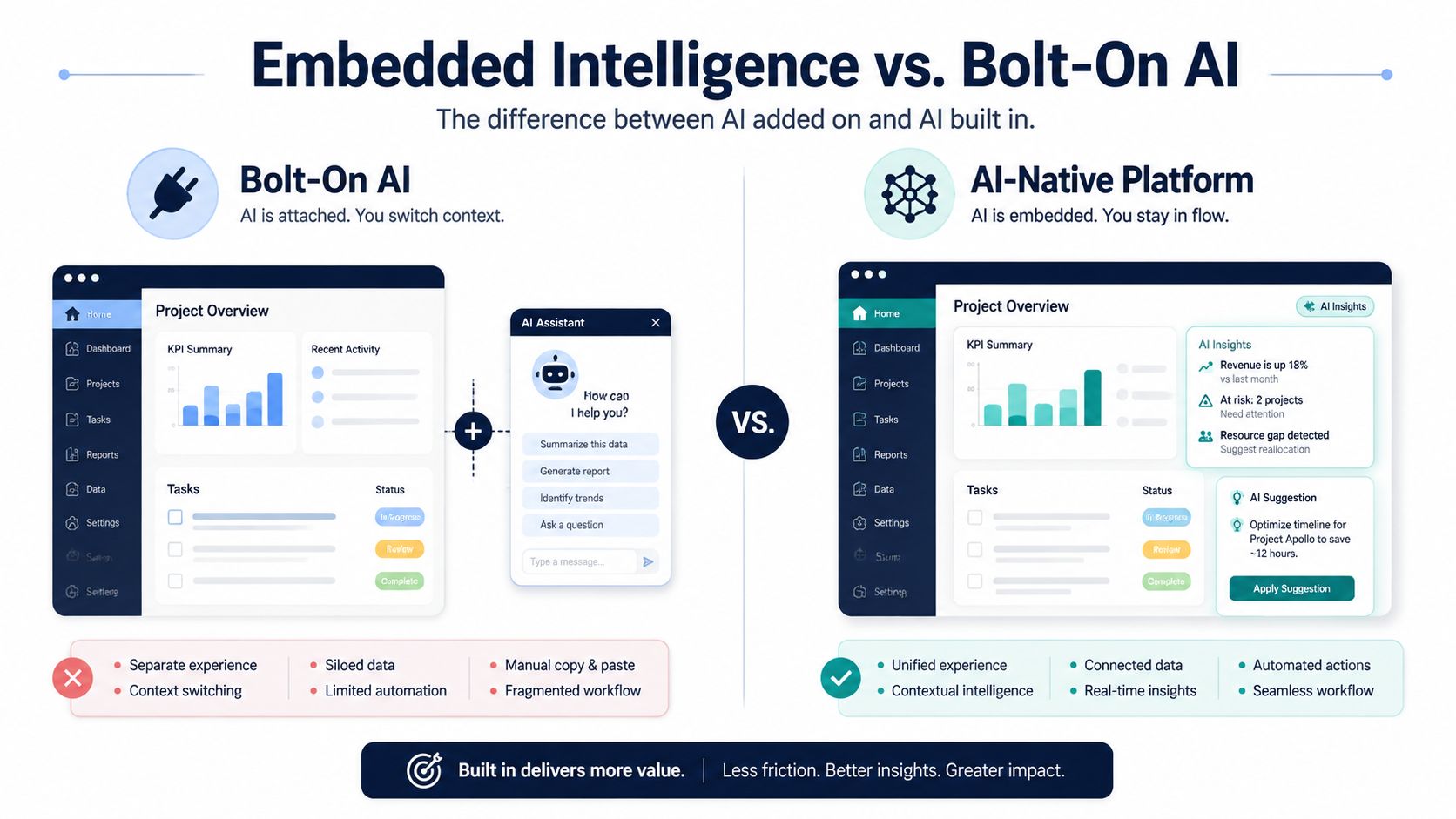
A revised quote exposes the operational difference between bolt-on AI and embedded intelligence. The question is not whether an assistant can write an email. It is whether the platform can assemble the business context behind that email without sending your team across several applications.
With bolt-on AI, the assistant usually sees records in the application where it operates. It can draft a message or summarize a note, but someone still checks pricing history, project capacity, purchasing status, and payment behavior elsewhere. The software produces text. Your team remains responsible for finding the facts, reconciling them, and deciding what the business should say or do.
An AI-native platform works from a shared model of customers, quotes, orders, invoices, projects, employees, and inventory. The assistant can connect the relationships that shape a decision. A quote recommendation may reflect previous orders, current project requirements, approved pricing rules, available capacity, and purchase commitments, subject to your permissions and approval rules.
Context is the real test, not conversation
A chat box does not make software AI-native. Ask vendors which records the assistant can use, which workflows it can affect, and where approvals remain required.
- Bolt-on pattern: The assistant drafts a project update, while a manager gathers the source facts manually.
- Embedded pattern: The platform combines assignments, tracked time, milestones, messages, and risks to produce a status summary inside the project workflow.
- Bolt-on pattern: The finance assistant identifies an invoice, but someone checks whether the related delivery was accepted.
- Embedded pattern: The system connects the invoice, order, delivery status, customer record, and payment history before proposing a follow-up.
The architecture described in Sema4's guidance on AI-native enterprise architecture centers on native context modeling, agentic reasoning, and natural-language interaction as system primitives. A multi-step process needs state. If the assistant cannot retain relevant information from another department, it remains a point tool, regardless of how polished its answers sound.
Zynthoro presents Claude Sonnet as integrated across its business domains, with AI assistants supporting workflows rather than operating as a separate destination. Evaluate the path from request to governed action. If your staff must rebuild the context before the assistant can help, the platform is passing its hidden operating cost back to you.
For a solo founder testing this approach, Kickstarter is listed as Kickstart 1, with a €79 one-time price, lifetime access, AI Assistants with 50 credits per month, Planning & Time Tracking, the Communication module, and Canva Studio.
Real Benefits for Small and Medium Businesses
The value of an AI-native platform appears in the handoffs between departments. A finance process becomes more useful when it knows what sales promised and what operations delivered. A project update becomes more reliable when it draws from actual time records, messages, deadlines, and assigned work instead of a manually assembled status note.
Start with invoicing. An embedded assistant can identify invoices approaching their due date, connect them to the relevant customer and order, draft a suitable follow-up, and route the message for approval. Reconciliation also improves when payments, invoices, accounting records, and customer information share the same data model. Your finance lead still controls exceptions, but the routine search and matching work no longer depends on opening several applications.
Finance and sales gain a shared operating picture
Sales teams benefit from continuity rather than isolated automation. A quote can carry its customer details into the order, preserve the agreed terms for invoicing, and remain connected to delivery and project information. The assistant can help draft a response using current records, while the salesperson makes the commercial judgment.
The same principle applies to customer service. Instead of asking a colleague to search for the latest update, a team member can request a summary that includes the customer's open work, recent communication, outstanding invoice, and next internal action. That answer is useful because it is connected to action, not because it is eloquently written.
Operations can plan with the facts finance already uses
Production and field teams expose the weakness of disconnected tools quickly. Scheduling based only on a calendar ignores employee capacity, inventory, work orders, recipes, quality checks, and customer deadlines. A connected platform can bring those constraints into one planning conversation.
Zynthoro's production capabilities include recipes, multi-level bills of materials, work orders, quality control, lot traceability, and cost roll-ups for food, cosmetics, pharma, and light manufacturing. That gives an SME a route from a customer order to the materials, work, checks, and costs associated with delivery.
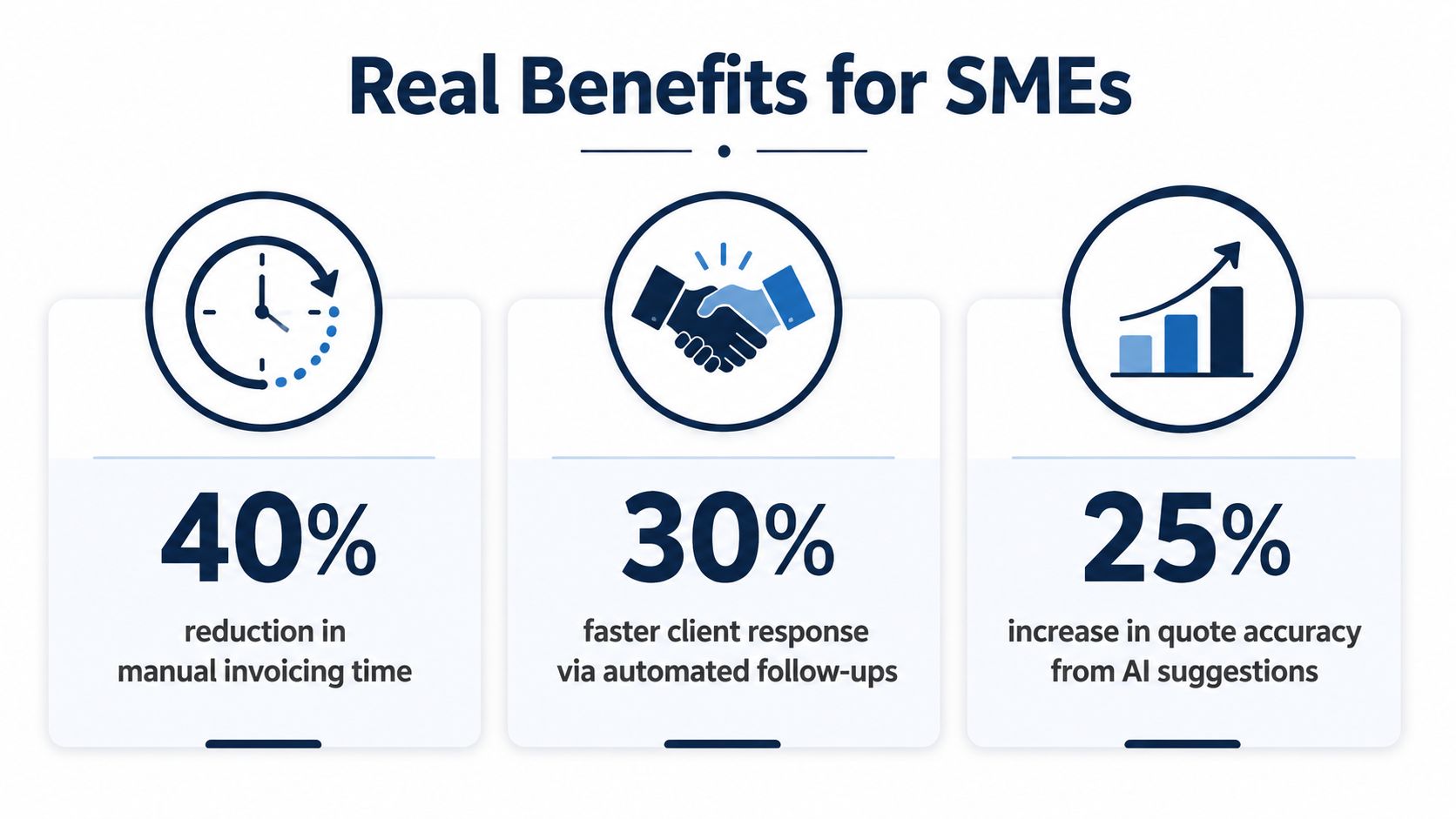
Be careful with promised performance figures. The infographic supplied for this topic presents claims of a 40% reduction in manual invoicing time, 30% faster client response through automated follow-ups, and a 25% increase in quote accuracy from AI suggestions. Treat those as target outcomes to validate in your own workflow, not as guaranteed results.
The stronger buying principle is simpler: choose automation that removes a handoff, preserves context, and leaves an auditable record of what happened.
Key Capabilities to Evaluate Before You Buy
Vendors use “AI-native” loosely. You need a test that exposes whether the platform is structurally integrated or just decorated with a chatbot.
Begin with the data model. Ask whether customers, suppliers, invoices, projects, employees, inventory, and production records share identifiers and permissions. Then test a real cross-functional request, such as, “Which overdue customers have active projects, and what should we do next?” If the answer requires exports or manual uploads, the AI layer isn't embedded.
Evaluate the operating layer, not the demo script
A practical review should cover these capabilities:
- Unified business context: The assistant should connect records across departments without forcing users to restate facts.
- Action controls: The platform should distinguish between suggesting an action and executing one, with approvals for sensitive changes.
- Continuity in real time: Changes to an order, invoice, schedule, or work order should become available to relevant workflows without repeated imports.
- Voice access: Hands-free input matters for production floors, warehouses, vehicles, and field work. Zynthoro lists voice input across devices through Zyntha, Thoro, Zyona, and Zynthoro Assist.
- Production depth: Manufacturers should look for recipes, bills of materials, quality control, lot traceability, and cost roll-ups rather than a generic task board.
- Residency and privacy: Ask where data and inference are hosted, whether a data processing agreement exists, and whether prompts are excluded from model training.
- Governance and observability: Require role-based access, audit trails, policy enforcement, usage monitoring, and clear ownership for AI tools.
The architecture guidance from UnifyApps emphasizes a unified context layer, governed action layer, AI gateway, tenant-aware policies, PII redaction, and token budgets. You don't need to implement those controls yourself, but your vendor should be able to explain their equivalent.
| Capability | Why It Matters | Zynthoro Delivery |
|---|---|---|
| Unified data model | Prevents repeated entry and disconnected answers | Single workspace spanning twelve business domains |
| Cross-module AI context | Lets assistants reason across finance, sales, HR, and operations | Embedded assistants connected to platform workflows |
| Governed actions | Protects approvals and financial controls | Workflow-based actions with role and permission controls |
| EU hosting and privacy controls | Supports residency and GDPR requirements | EU-hosted environment with GDPR-ready controls |
| Auditability | Shows who changed or approved a record | Audit trails and role-based access |
| Production traceability | Links materials, checks, lots, and costs | Recipes, BOM, QC, lot traceability, and cost roll-ups |
| Voice interaction | Reduces device and keyboard dependence | Hands-free voice input across devices |
For a solo founder comparing entry points, Starter No Credits is listed at €499 per month and includes basic planning and time tracking, basic content and communication, one company workspace, one user, one email, three aliases, and no ERP.
How AI-Native Platforms Work in Daily Operations
At 8:30 in the morning, a sales manager asks for a quote recommendation for a returning customer. The platform can use the customer record, previous orders, current opportunity, relevant project details, and available operational context to prepare a starting point. The manager reviews the assumptions, changes what needs changing, and sends the approved quote without searching through old files.

At 10:00, a production supervisor is walking the floor and notices a quality issue. Instead of waiting to return to a desk, the supervisor can use voice input to record the check against the relevant work order or lot. The record stays attached to the operational process, so another employee doesn't need to decipher a message and enter it again.
At midday, the finance lead asks for a cash position. The useful answer isn't a generic forecast. It should bring together invoices, pending customer payments, approved purchase orders, and known commitments, then show which items require attention. The finance lead can investigate the underlying records rather than treating the assistant's summary as an unexplained conclusion.
The best assistant doesn't replace the person accountable for the decision. It prepares the right context before that person acts.
Later, marketing prepares a campaign for a product with constrained inventory. Connected data can help the team avoid promoting unavailable stock and can keep campaign content aligned with current offers and operational realities. The benefit comes from shared records, not from asking a writing model to guess what the business can deliver.
Zynthoro's connected modules matter in practice. Planning, time tracking, purchasing, sales, accounting, invoicing, projects, HR, operations, marketing, communication, compliance, and production can participate in one operating environment. The user still sees a role-specific workflow, but the underlying context doesn't stop at the application boundary.
The following video provides another visual way to understand AI-assisted business workflows.
Security and Governance You Cannot Ignore
An AI assistant with access to invoices, employee records, customer conversations, and production data needs stronger controls than a general-purpose chatbot. Convenience isn't a security model.
The first requirement is permission-aware access. A sales employee may need customer and opportunity information but not payroll records. A production supervisor may need lot and quality data without seeing sensitive HR details. The assistant must inherit those boundaries rather than becoming a back door into the entire database.
Controls should be visible in ordinary work
Auditability matters just as much as access. When an assistant proposes or performs an action, the platform should record the relevant user, time, source records, approval, and resulting change. Finance teams need to explain an invoice adjustment. HR teams need to understand who accessed or changed a personnel record. Operations teams need to trace a quality event to the relevant work order or lot.
EU hosting also deserves a direct conversation with the vendor. Reporting on EU data residency and GDPR-focused AI infrastructure highlights why buyers now ask where data is stored and where inference occurs. Ask for clear answers about regional storage, model processing, data processing agreements, and whether customer prompts or records are used to train models.
Forbes coverage of AI and ERP governance makes the operational point plainly: AI doesn't eliminate approval processes, audit logs, data ownership, or segregation of duties. An AI-native platform must preserve those controls while reducing manual work.
A practical SME governance routine includes:
- Named ownership: Assign responsibility for each AI-enabled workflow.
- Data categories: Define what customer, financial, employee, and production information assistants may process.
- Review cadence: Inspect usage, exceptions, and policy changes regularly.
- Action thresholds: Require human approval for payments, payroll changes, pricing exceptions, and other sensitive write-backs.
- Incident process: Give staff a clear route for reporting an incorrect answer, unsafe action, or privacy concern.
Zynthoro's stated reference model includes an EU-hosted environment, GDPR-ready controls, audit trails, and role-based access. Verify the implementation, documentation, contractual terms, and configuration options before putting sensitive workflows into production.
Your Path to Consolidated Operations
Start with an inventory of your current stack. List every application, subscription, spreadsheet, shared inbox, and manual export involved in invoicing, sales, delivery, staffing, purchasing, and reporting. Then mark every handoff where a person copies information or asks another person to confirm the latest version.
Choose one workflow with a clear owner and visible friction. Invoice chasing is often a useful starting point because it connects customer records, delivery status, payment information, communication, and accounting. Production businesses may start with quote-to-work-order continuity or lot traceability. Don't automate the most complicated process first. Automate the process where clean context can produce a clear operational decision.
Use vendor demos aggressively. Ask the assistant to answer a cross-functional question using your terminology. Request a proposed action, then ask what approval is required and where the audit record appears. Test a role with limited permissions. Ask where the relevant data is hosted and how model training, retention, and deletion are handled.
The wider market context supports consolidation. Codat's report on small business software fragmentation described the SMB software market as “heavily fragmented.” The answer isn't another assistant layered onto the mess. It's a governed operating layer that connects the work your people already perform.
Zynthoro is a candidate for that consolidation because it combines twelve business domains, embedded Claude-based assistants, EU hosting, operational workflows, and manufacturing features in one workspace. Assess it against your real processes, permissions, and reporting requirements, not a feature checklist.
Zynthoro brings finance, sales, projects, HR, operations, communication, marketing, and production into one AI-native platform with connected context and governance controls. Visit Zynthoro to review the platform and decide which disconnected workflow you'll consolidate first.