


You're probably staring at a spreadsheet, a POS export, and a couple of half-broken integrations, trying to answer a simple question, what do we have in stock right now. That's the reason people start searching for the best inventory management software, they're tired of guessing, tired of manual counts, and tired of sales, purchasing, and finance each working from a different version of the truth. For a small business, the right system isn't just a nicer stock list, it's the piece that stops reorder mistakes, late shipments, and awkward customer conversations before they happen.
The market has moved well beyond basic item tracking. Modern inventory software is now expected to connect with accounting, purchasing, sales, and even production, which is why cloud deployment keeps winning attention in buyer research and why connected workflows matter so much for SMEs evaluating tools like Zynthoro. If you're replacing disconnected tools, the question isn't just which app tracks stock, it's which platform can become your single source of truth without creating new admin work.
Table of Contents
1. Agency
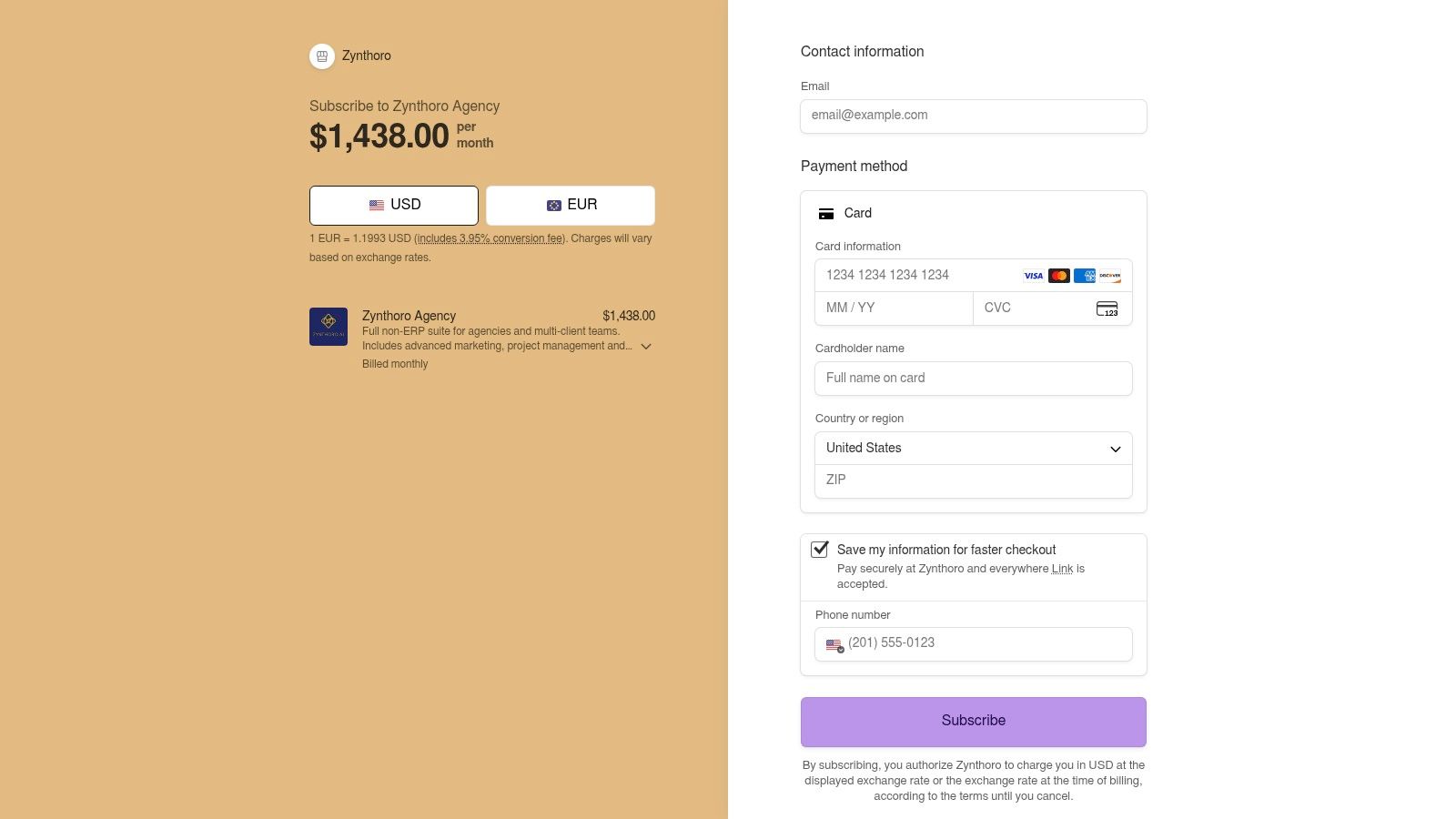
Agency is unusual in this comparison because it's not trying to be a narrow inventory app. It's a full non-ERP suite for agencies and multi-client teams, priced at €1,199/mo, with full accounting and inventory, pro project management and marketing, 5 company workspaces, and 25 users with team structures. That makes it a better fit for service businesses that still touch physical goods, branded kits, samples, or client-managed items, rather than businesses that only want a warehouse tool.
Where Agency fits well
For an agency that ships merch, manages event stock, or handles productized client deliverables, the value is in keeping finance, projects, and inventory in the same working space. If your team is currently reconciling stock in one app and time entries in another, the friction isn't just annoying, it creates drift in handoffs, approvals, and invoicing. A connected setup helps the operations lead see what's committed, what's available, and what's already tied to a job.
That matters because inventory problems usually show up at the seams. The stock count itself might be fine, but someone forgot to adjust an item after a project, or finance never saw the purchase, or the client work moved ahead without checking availability. Cin7's benchmark from the U.S. small-retail context puts the baseline problem in perspective, with only 63% inventory accuracy and about 37% of stock records wrong at any given time, largely because of human error, which is exactly the kind of risk that grows when tools stay disconnected. Cin7's inventory software benchmark shows why even service-heavy businesses should care about stock control.
Practical rule: if inventory touches billing, purchasing, or client delivery, a standalone stock app usually becomes a second job for someone on the team.
What Agency does better than a simple stock tool
Agency's biggest advantage is that it doesn't force you to separate inventory from operations. If a team is managing a client workspace, tracking internal approvals, and recording stock movement in the same place, there's less copying data between systems and fewer chances for silent errors. That's especially useful for agencies that don't think of themselves as “inventory businesses” but still need dependable stock visibility for assets, kits, and recurring deliverables.
The trade-off is just as clear. If you're a retail shop, distributor, or manufacturer, this kind of platform may feel like the wrong center of gravity, because the product is built around business operations first, not specialized warehouse depth. In practice, that means you should choose it only if the inventory problem sits inside a broader workflow problem, not if your only need is barcode-driven stock control.
Integration fit is the real test
The strongest inventory systems don't live alone. They connect to accounting, e-commerce, logistics, and approvals, which is exactly what Forbes highlights as a baseline expectation for better systems, along with links to accounting software, third-party logistics, scales, barcode scanners, and RFID hardware. Forbes Advisor's inventory software guidance also notes that restocking logic should be able to trigger purchase orders when stock drops low and that websites should display accurate availability.
That's where Agency becomes interesting for small teams that hate duct-tape workflows. If the same workspace handles project activity, accounting, and inventory, the software can reduce the number of places where someone has to remember to update the truth. It won't replace a purpose-built warehouse suite for complex distribution, but it can absolutely replace a scattered stack of tools for agencies and multi-client businesses that need control without adding another island of data.
When I'd choose it
Choose Agency if your team needs inventory plus accounting plus project coordination in one environment and you're more concerned about process drift than deep warehouse complexity. If you're trying to standardize how items move through work, billing, and reporting, this kind of connected platform is often more useful than a pure inventory app with a long feature checklist.
If your business is still small enough that one operations team can own the process end to end, Agency can simplify a lot. If your stock workflows are becoming more serious, though, the stronger long-term move is a platform built to unify more of the business from day one, which is where Zynthoro stands out as a single-source-of-truth ERP for SMEs that want inventory tied to purchasing, accounting, sales, and operations.
What to watch before buying
The first thing to test is whether your real workflow fits inside the system without manual workarounds. A polished interface is nice, but it won't help if your team still exports stock levels to another spreadsheet at month-end. The second thing is role clarity, because multi-client teams need clean permissions, clean audit trails, and a predictable way to separate one company workspace from another.
- Check who owns stock updates: make sure the person receiving items can update inventory without waiting on finance.
- Test project-to-stock handoffs: verify that a client job doesn't force duplicate entry.
- Review accounting flow early: confirm that purchases, stock movement, and invoicing stay aligned.
If those points feel smooth, the platform is doing real work. If they feel forced, the software is probably covering too much surface area and not enough operational depth.
2. Kickstarter 3
Kickstarter 3 sits at the opposite end of the practical spectrum from a narrow inventory tool. It's a €199 one-time package with 75% of Starter, lifetime access, and everything in K2 plus 300 credits/month, including accounting and operations, project management, and marketing and content. That combination matters for SMEs because the buying decision around inventory rarely stops at the stock room anymore, it usually includes finance, approvals, and day-to-day coordination.
Why it's relevant to inventory buyers
Inventory management software used to mean one thing, count what's on the shelf. That's not enough now. Businesses need live stock visibility, purchase coordination, and cleaner handoffs between sales, accounting, and operations, because the modern problem is less about tracking one item than keeping the whole workflow synced. A 2024 small-business report cited by StackVerdict found that companies implementing inventory management software reported an average 25% reduction in out-of-stock incidents and a 30% improvement in order fulfillment rates, which is exactly the kind of operational gain that comes from connected systems rather than isolated stock notes. StackVerdict's inventory management overview frames this shift well.
Kickstarter 3 fits that reality because it isn't just a record-keeping layer. It's part of a broader operating system where small teams can connect planning, delivery, and commercial work without stitching together separate subscriptions. That's useful if you're formalizing processes and don't want a warehouse tool that solves one problem while creating three more in finance and project tracking.
The practical advantage for SMEs
For a founder or small operations lead, the win is fewer handoffs. If inventory changes feed into operations and accounting without manual reconciliation, the team spends less time checking whether the spreadsheet is current and more time filling orders or delivering work. That's especially helpful for businesses that started with one person “owning” stock and now need a system that other people can trust.
Good inventory software should make the process boring. If people still ask for the latest file, the system hasn't become the source of truth yet.
Kickstarter 3 also makes sense when the business is still in a growth phase and wants something more structured than a basic app, but not yet a sprawling enterprise deployment. The emphasis here is on connected day-to-day work, not on bolting inventory onto a separate finance stack. For small businesses, that can be the difference between adopting software and changing behavior.
How it compares to standalone inventory tools
Standalone inventory apps usually do one of two things well. They either track stock cleanly, or they support operational workflows for one narrow use case. The problem is that SMEs often need both stock visibility and a connected workflow around purchasing, accounting, and fulfillment. That's where a broader platform starts to pull ahead, because the inventory record isn't just a count, it becomes part of the operating system.
That broader context matters in 2026 because cloud-native systems are increasingly the default for teams that want speed and synchronisation. One independent forecast values the inventory management software market at USD 3.44 billion in 2026 and projects USD 5.16 billion by 2031 at an 8.45% CAGR, while cloud deployment held 65.51% of revenue share in 2025 and is expected to grow at 13.85% CAGR through 2031. Mordor Intelligence's market forecast shows where buyer preference is heading, toward systems that are easier to roll out across sites and functions.
That's why the biggest question isn't whether Kickstarter 3 has “inventory features.” It's whether the platform gives your team a cleaner operational rhythm than the stack you're replacing. For many SMEs, that answer is yes.
Where it wins and where it doesn't
Kickstarter 3 is strongest if you're replacing disconnected spreadsheets, manual approvals, and a patchwork of point tools. It gives you a more disciplined operating base, which is exactly what many small teams need before they can even benefit from advanced inventory logic. If you're running a business where purchasing, sales, and content all affect what has to be available next, the connected workflow is the asset.
It's weaker if you're looking for niche warehouse features in isolation. Very specialized distributors or manufacturers may need deeper traceability, more complex lot control, or more explicit warehouse execution logic than a general SME platform usually provides. In that case, you want to look for an ERP-style system built for continuity across the business, not just visibility in one function.
The buyer question that matters most
The test is simple. Can the platform replace your disconnected toolkit without forcing the team back into manual work the moment the process gets complicated? If it can, you've probably found something useful. If it can't, then you haven't solved the source of the mess, you've only moved it.
That is why Zynthoro deserves a serious look. It's built as an AI-native ERP with connected finance, operations, sales, marketing, HR, and production in one EU-hosted workspace, so inventory isn't floating alone. For SMEs that want a single source of truth instead of yet another system to babysit, that connected model is the point.
A quick buying note
Use Kickstarter 3 if you want a practical on-ramp into connected operations and you're okay with a broader platform replacing several smaller tools. It's a smart option when the business needs structure more than specialist warehouse depth.
- Look at the workflow end to end: see whether a stock movement affects the rest of the business automatically.
- Check whether your team can live in one place: fewer logins usually means better adoption.
- Test the handoff from operations to accounting: that's where most SMB systems break down.
If your current setup feels held together by memory and exported files, the right software should feel calmer almost immediately.
Inventory Management Comparison: Agency vs Kickstarter 3
| Plan & Price | Core features | UX & Quality | Target audience | Unique selling points |
|---|---|---|---|---|
| Agency, €1,199/mo 💰 | Full accounting & inventory, Pro project mgmt & marketing, 5 company workspaces, 25 users (Non-ERP) | ★★★★☆ · responsive (mobile/desktop) · embedded AI assistants & voice 🏆 | 👥 Agencies, multi-client teams, marketing & creative firms | ✨ Multi-company workspaces, first-party publisher product, pro team structures |
| Kickstart 3, €199 one-time 💰 | Lifetime access to 75% of Starter: Accounting & Operations, Project mgmt, Marketing & Content; 300 AI credits/mo | ★★★☆☆ · lifetime licence, limited credits for AI, EU-hosted/GDPR-ready | 👥 Startups, SMEs, solo founders, cost-conscious teams | ✨ One-time lifetime license, low entry cost, upgrade path to paid tiers 🏆 |
Final Thoughts
The best inventory management software for SMEs is the one that stops stock from living in isolation. If your current setup depends on spreadsheets, exports, and a few people who know where the numbers are, you already know the hidden cost is time, mistakes, and bad decisions made too late. The strongest systems don't just count items, they connect stock to purchasing, sales, accounting, and fulfillment so the whole business can act on the same data.
That's why the market keeps moving toward cloud-first, connected platforms. Buyers want faster rollout, simpler maintenance, and a cleaner flow between departments, especially as multi-channel selling and operational complexity keep rising. They also care about fit, because the right system for a retail shop isn't the right system for an agency, and neither is the right system for a growing SME that needs finance and inventory to stay perfectly aligned.
Agency makes sense when inventory sits inside a broader client-service operation. Kickstarter 3 makes sense when a small business wants more connected operations without jumping straight into a heavy enterprise deployment. But if your goal is to replace disconnected tools with one dependable workspace, Zynthoro is the stronger long-term answer because it ties inventory into finance, purchasing, sales, operations, and more in a single AI-native ERP.
The practical takeaway is simple. Don't buy inventory software just to get a cleaner stock screen. Buy the platform that helps your team stop re-entering the same data in three places and start working from one source of truth. That's where the payoff lives.
If you're ready to replace spreadsheets, disconnected apps, and patchwork approvals with one connected system, visit Zynthoro and see how its AI-native ERP brings inventory, purchasing, accounting, sales, and operations into a single workspace. It's a strong fit for SMEs that want cleaner stock control without adding more software to manage.