


You know the feeling. The quote lives in one app, the invoice sits in another, the project handoff is buried in email, and someone is asking why payment still hasn't landed. The work looks simple on paper, but every tool switch adds a pause, every manual copy-paste adds risk, and every missing handoff turns into a fire drill for the owner.
Business process improvement starts there, not with a grand redesign. It starts with seeing where work breaks, then fixing the process that costs the most time, money, or customer trust. For SMEs replacing disconnected tools, that usually means moving from scattered activity to cross-functional ERP data, where approvals, invoices, tasks, and communication all live in one place with a clear audit trail.
Table of Contents
- Why Your Disconnected Tools Are the Real Bottleneck
- The Business Process Improvement Cycle Explained
- How to Choose Which Process to Fix First
- The KPIs That Prove Improvement Happened
- Where Automation and AI Create the Biggest Gains
- Building a Continuous Improvement Operating Rhythm
- From Fragmented Tools to a Single Source of Truth
Why Your Disconnected Tools Are the Real Bottleneck
A small business owner usually blames people first. Someone forgot to send the invoice, someone else approved a quote late, and the project manager says the brief never arrived. In practice, the problem is often the gap between systems, not the person using them.

A day in the life of a fragmented workflow
A typical SME owner starts in a CRM, jumps to a spreadsheet for pricing, checks email for a customer reply, and then opens accounting software to create the invoice. Each handoff seems minor. Together, they create the delays that make business process improvement urgent.
The problem gets worse when the same data has to be entered twice. A quote lives in one place, the order lives in another, and the invoice needs a fresh set of details because there's no shared workflow. That's how errors creep in, and it's why documentation alone doesn't fix anything.
Practical rule: if the same customer detail has to be typed more than once, the process is already leaking time.
A unified system matters. Zynthoro brings finance, operations, sales, HR, and communication into one workspace, so the owner can see the workflow end to end instead of chasing pieces across tabs. In that kind of setup, the bottleneck becomes visible, which is the point.
The practical shift is simple. Stop asking, “Who dropped the ball?” and ask, “Where did the process lose continuity?” That question usually exposes the constraint, which is often a disconnected handoff rather than a lack of effort.
The Business Process Improvement Cycle Explained
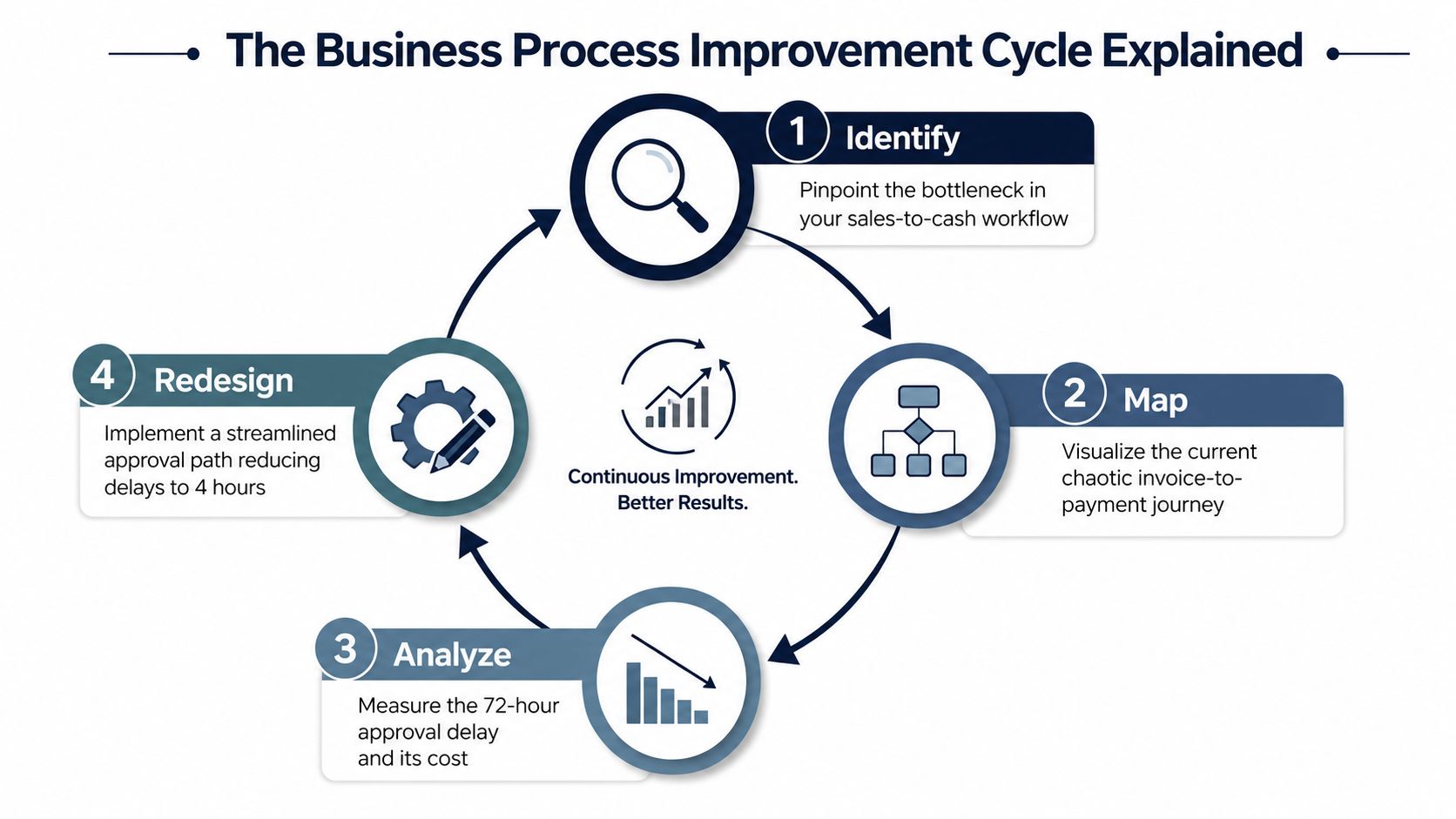
A process fix only works when it follows a sequence the team can repeat. Start by identifying the pain point, map the current flow, analyze where the work slows or breaks, then redesign the process so the same issue does not keep resurfacing. NetSuite describes this as identifying the process, mapping it, evaluating the results, and then standardizing and documenting the improved version so it can be trained and reused, while TechTarget frames it as identifying what needs to change, analyzing pain points, conducting root cause analysis, designing, implementing, and then quantifying the result NetSuite's process improvement overview.
Use a sales-to-cash workflow as the model
A sales-to-cash flow is a practical starting point. A customer asks for a quote, the team prepares a proposal, the deal closes, the invoice goes out, and payment arrives. On paper, that looks simple. In practice, the map often reveals hidden approvals, duplicate data entry, and a handoff that sits in someone's inbox until the job stalls.
Mapping has to come before redesign because guesses lead to the wrong fix. With a process map, the team can see whether the delay sits in quote approval, invoice generation, or reconciliation after payment. Without that view, the loudest complaint usually gets attention, even if it is not the true constraint.
The process becomes easier to prove when the system records each step. A platform like Kickstarter, listed as Kickstart 1, includes AI Assistants, Planning & Time Tracking, a Communication module, and Canva Studio, which can support early process visibility when a small team is still stitching work together across tools.
What redesign should change
Redesign should remove friction, not just rename it. If quote data has to be retyped into invoicing, the redesign should turn approved quote details into an invoice draft automatically. If approval always waits on one manager, the redesign should route it by rule so the delay does not depend on a single inbox.
Documented process mapping is required for repeatable improvement. If the current workflow is not visible, the new one will drift as soon as people start handling exceptions their own way.
How to Choose Which Process to Fix First
Many SMEs are carrying several broken processes at once. The mistake is treating every pain point as if it deserves equal attention, then fixing the one that complains the loudest instead of the one that constrains cash, capacity, or customer delivery.
Rank by value, pain, and feasibility
A practical way to sort the options is to score each candidate on three factors, business value, pain level, and feasibility. Then compare the cost of delay with the effort required to fix it. A process that is annoying but low-impact can consume time without changing business results, which is why some improvement work feels active but leaves the bottleneck in place.
The trade-offs are usually clearer once you look across finance, operations, and customer-facing work. Invoice reconciliation often has direct financial impact because it affects cash, reporting, and follow-up. Purchase approvals can free up operations, but only if the delay is blocking inventory or delivery. Onboarding can improve the customer experience quickly, but only if it sits close enough to revenue or retention to matter.
Useful filter: start with the process whose delay shows up in cash, customers, or capacity, not the one that looks worst on a whiteboard.
The 4U framework helps because it separates underserved problems from merely urgent ones. A process can feel chaotic and still deliver little business value if the fix will not move a meaningful metric. That is the trap for SMEs with limited change capacity, especially when the team is trying to improve several workflows at the same time.
Build a simple prioritization matrix
A simple matrix is enough in most cases. Put each workflow into one of four boxes, high impact and low effort, high impact and high effort, low impact and low effort, or low impact and high effort. The first box gets attention first. The last box gets ignored unless compliance requires it.
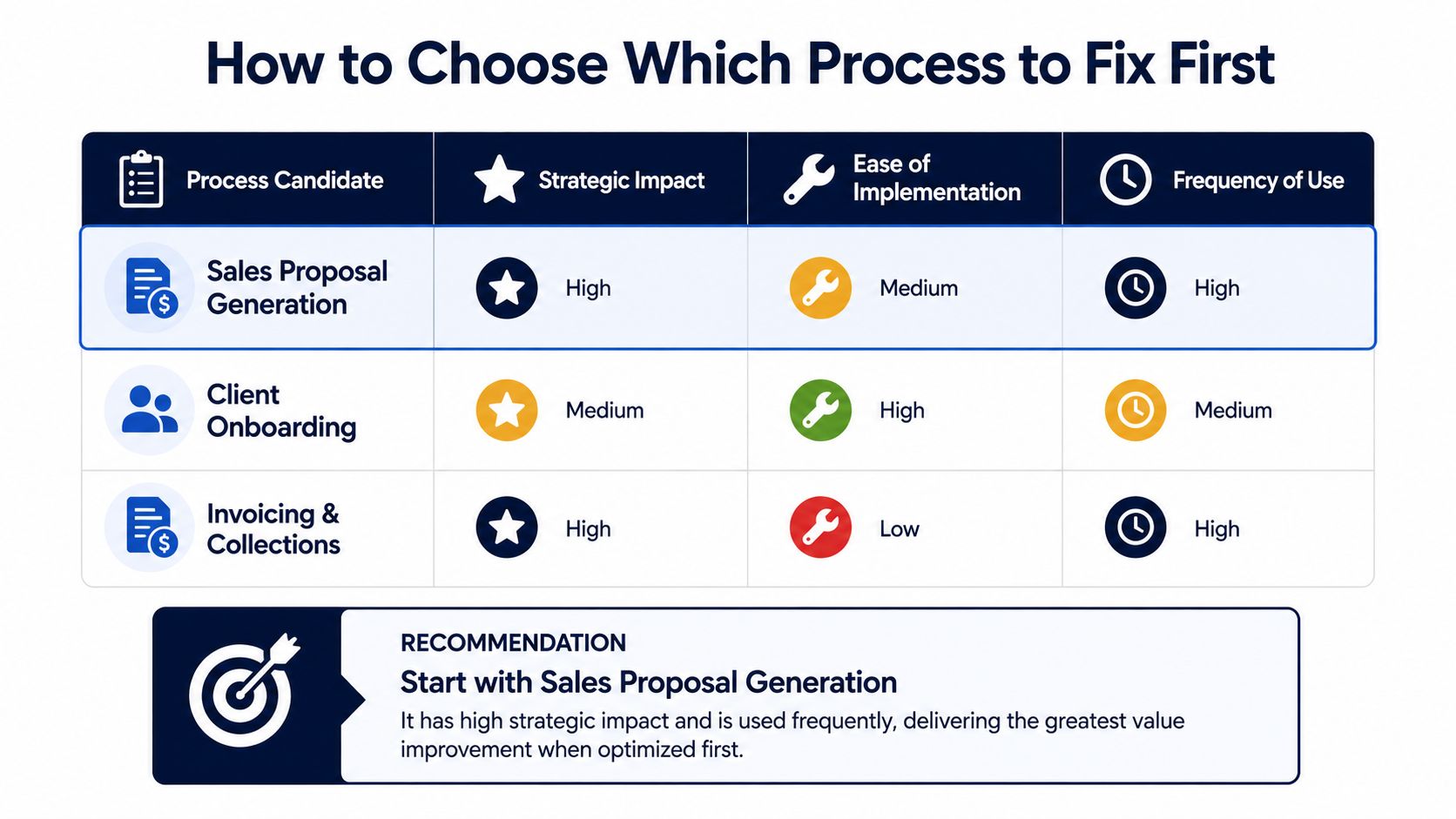
If two workflows look similar, pick the one that happens more often. A small gain on a daily process usually beats a larger gain on something that happens once a month. That is the trade-off that makes business process improvement practical instead of theoretical, especially when a team needs visible results from cross-functional ERP data rather than another round of opinions.
The KPIs That Prove Improvement Happened
A process change without measurement is just a guess with better branding. The historical gap is striking. A 2016 survey of 236 Polish companies found that 69% had documented, repeatable processes, but only 4% actively measured and managed those processes, and 96% had some kind of documented process in 2015 process documentation and measurement gap. That gap explains why so many initiatives look finished even when the work still behaves the same.
Track a small set of metrics
The useful KPI set for SMEs is narrow. Cycle time tells you how long work takes from start to finish. Cost per transaction shows how much labor you're spending per unit of work. Error rate measures how often work needs rework. Automation rate shows how much of the work is handled without manual intervention. Lead time shows how long objects take to reach the final stage of the process.
SAP Signavio recommends metrics such as automation rate, lead time, and change rate, and ties them directly to throughput and operational efficiency SAP Signavio process performance indicators. That matters because broad dashboards hide the core issue. Small teams need process-level indicators, not generic reporting noise, and they need them tied to the workflow they are trying to fix.
What redesign should change
The measurement loop has to start before redesign. Record current cycle time, error rate, and handoff delays. Then make one change, not five, and compare the result against the baseline.
Closed measurement-improve-control cycles work only if the data is stable enough to compare from one version of the process to the next. AMOS describes that approach by benchmarking automation rates, cycle times, error rates, and reporting speed, then testing changes in controlled environments before rolling them out AMOS adoption metrics. A target like completing reporting in under 7 business days after a process change is useful because it gives the team a clear pass or fail line.
If you can't timestamp handoffs and count exceptions, you can't prove the process improved.
That is the core instrumentation problem. For Zynthoro users, the advantage is that the same workflow can carry approvals, invoices, task status, and the communication trail in one place, which makes the before-and-after comparison easier to trust.
Where Automation and AI Create the Biggest Gains
Automation creates the biggest return when it removes handoffs, not just keystrokes. If a team still moves files from sales to finance to operations by hand, AI can speed up pieces of the work, but the process will still break at the seams. The gain comes when the data flows continuously across functions.
Fix the handoff before you automate the task
Invoice sending and chasing are obvious candidates because they're repetitive and measurable. Project status summaries are another good fit when managers keep rewriting the same update for different audiences. Approval routing also helps when work waits in an inbox because no one knows who owns the next step.
Hands-free voice input matters for teams in the field or on a production floor, where typing slows people down. Zynthoro supports embedded AI assistants powered by Anthropic Claude, along with voice input across devices, so people can capture work where it happens instead of recreating it later. That matters most in environments where delays start with missing context.
The market is clearly moving in this direction. One industry summary reports that the BPM market was valued at $11.84 billion in 2021 and is projected to reach $26.18 billion by 2028, implying a 12.0% CAGR over that period, while another projects growth from $14.46 billion in 2022 to $61.17 billion by 2030, a 19.9% CAGR BPM market projections. Those figures show that process improvement has become a software category, not just a management habit.
Use AI where context is complete
AI works better when it sees the full process. Fragmented tools give it partial context, which makes the output weaker and the controls harder to manage. That becomes a bigger issue in AI-heavy, cross-functional environments, especially when approval paths, data access, and audit requirements all matter at once.
McKinsey reported in 2024 that 65% of organizations were regularly using generative AI, up from 33% the prior year, and IBM's 2024 research found the average cost of a data breach reached USD 4.88 million AI adoption and breach cost context. The takeaway for SMEs is straightforward. AI should sit inside a controlled workflow, not outside it.
Building a Continuous Improvement Operating Rhythm
Improvement fades fast when it is treated like a project with a finish line. Teams redesign a workflow, feel the short-term lift, then slide back into old habits unless someone keeps measuring, reviewing, and correcting. Business process improvement needs an operating rhythm, not a launch.
Make the review cycle monthly
For most SMEs, a monthly review is enough. Check automation rates, cycle times, error rates, and backlog against the baseline, then look for drift. If one metric worsens, the next question is direct. Is the process design weak, is training not holding, or is the data unreliable?
The best review meetings stay short and blunt. They should answer three questions. What changed? What improved? What slipped?
Use governance as the process evolves
AI-heavy workflows need tighter governance than a basic BPI playbook usually covers. Audit trails show who approved what. Role-based access controls reduce accidental exposure. Controlled tests help teams avoid rolling out a change that looks efficient but creates compliance risk.
That matters even more for European SMEs working under GDPR. A workflow that touches customer data, employee records, or finance data cannot rely on informal checks. Zynthoro's EU-hosted setup, audit trails, and role-based access support the kind of control that keeps improvement from turning into chaos.
Operating rule: do not expand automation faster than you can explain, audit, and reverse it.
If reporting is a pain point, set a time-bound benchmark and verify it. A target like completing reporting in under 7 business days only matters if the team tracks it consistently after each change. AMOS adoption metrics helps frame that discipline. It turns improvement into an operating habit instead of a one-off event.
From Fragmented Tools to a Single Source of Truth
A lot of SMEs start with a patchwork. Quotes live in one app, invoices in another, project tasks in a third, and communication in a fourth. That setup can work for a while, but it eventually creates invisible delays, duplicate data entry, and inconsistent records.
Zynthoro replaces that sprawl with a single AI-native ERP workspace across finance, operations, sales, HR, and communication. In a real SME setup, that means a quote can flow into invoicing, task status can update in the same system, and the owner can see the whole process without stitching together screenshots from different tools.
The difference shows up in the numbers you already care about. Cycle time gets shorter because fewer steps are manual. Error rate drops because the same data isn't retyped. Reviews become more useful because the team is looking at one source of truth instead of arguing over which app is current.
Start with one high-priority process, not the whole business. Baseline the KPIs, fix the biggest manual-rework hotspot, and set a monthly review rhythm that keeps the change alive. That's the practical path from scattered tools to measurable improvement.
If you're ready to stop managing work across disconnected apps, take a look at Zynthoro. It brings finance, operations, sales, HR, and communication into one workspace, which makes process improvement visible, measurable, and easier to keep in place.