


If you're running a food SME, you already know the pattern. A batch number is missing from a spreadsheet, a retailer asks for proof on a shipment, and your team spends the next two days hunting through emails, printed logs, and whatever system somebody last updated. The product was made correctly, maybe, but the records are scattered, so the business looks less controlled than it is.
That's why ERP for food manufacturing matters. It's not about buying another dashboard. It's about making sure recipes, lots, quality checks, inventory, and invoicing all tell the same story before the next recall, audit, or margin leak turns a manageable issue into a cash problem.
Table of Contents
- Why Food SMEs Need ERP Before the Next Recall
- What ERP for Food Manufacturing Actually Means
- The Core Modules a Food Manufacturing ERP Must Cover
- EU Compliance, Data Residency, and Audit Readiness
- Where AI and Automation Actually Pay Off in a Food SME
- Choosing the Right Vendor Without the Demo Theatre
- Implementation, Migration, and the First 90 Days
- ROI, Recall Readiness, and Why Acting Now Matters
Why Food SMEs Need ERP Before the Next Recall
A small sauce maker can survive a lot. It can survive a late supplier, a rushed production change, even a bad packaging run. What it can't survive is weak data continuity when a retailer calls about a possible allergen mislabel on one shipment and wants answers fast.
That's when disconnected tools collapse. The batch log lives in one file, purchasing history lives in another, quality notes are in email, and the warehouse knows which pallets moved but not why. Every person on the team works harder, and none of them gets a clean answer quickly enough.
The real cost isn't software, it's uncertainty
The subscription bill for another tool is rarely the painful part. The cost is the time lost while someone reconstructs what happened, the margin lost when a product has to be quarantined longer than necessary, and the customer trust lost when you look disorganized under pressure.
Food companies were already treating ERP as mainstream infrastructure years ago. In a 2020 industry survey cited by Food and Drink Business, 58% of companies were already using ERP and another 31% planned to use it or were highly interested, yet only 22% were controlling information and material flows at the shop-floor level. That gap is the problem. Plenty of SMEs have an ERP on paper. Far fewer have one that protects production reality.
Practical rule: If your team can't trace a lot from supplier receipt to customer shipment without opening three systems, you're exposed.
That's why I treat ERP as operational insurance for food SMEs. It doesn't just help you run the business on a normal day. It stops a bad day from becoming an expensive one.
What ERP for Food Manufacturing Actually Means
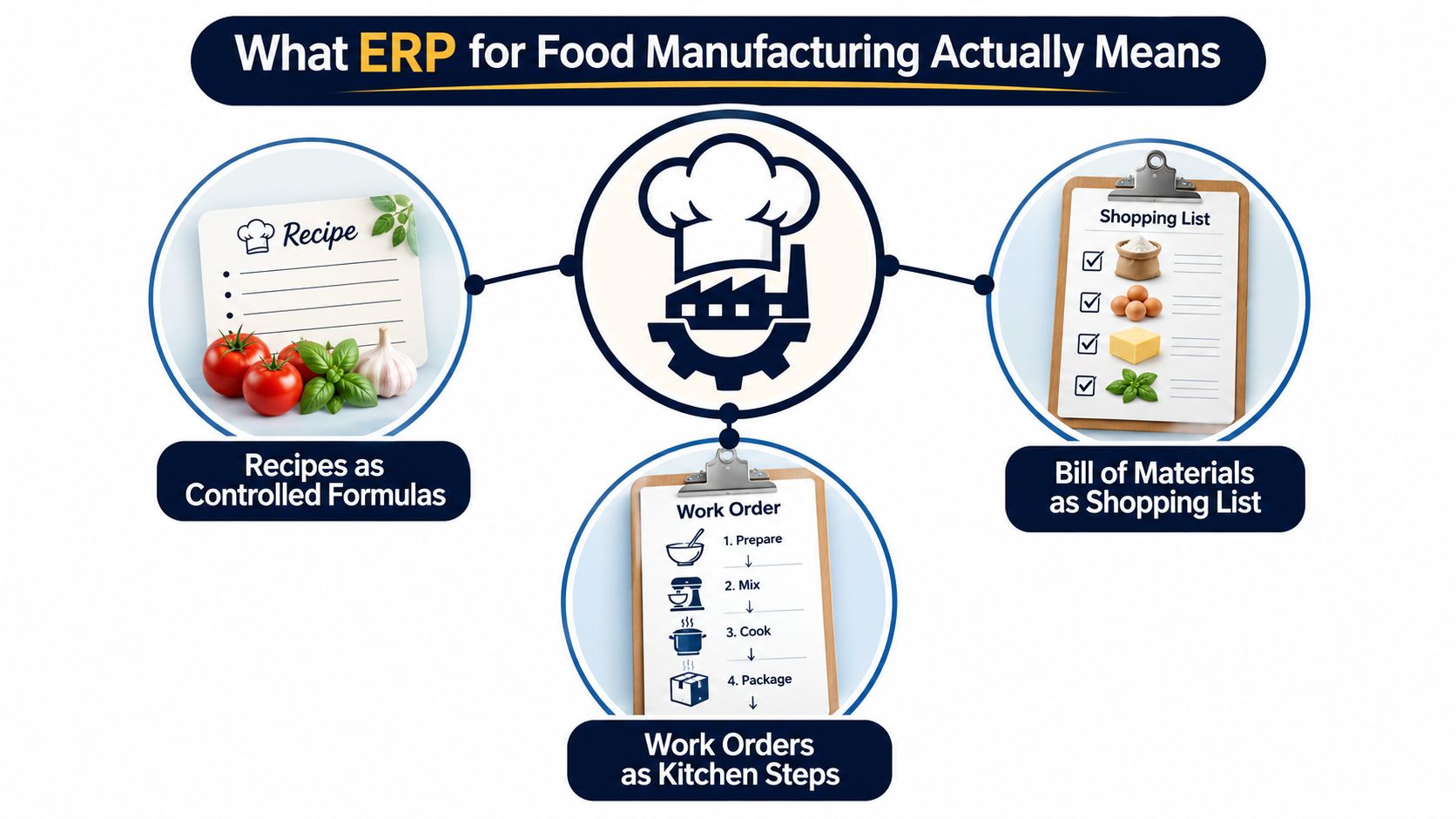
Food ERP is easiest to understand if you stop thinking like an accountant and start thinking like a kitchen manager. A recipe is a controlled formula. The bill of materials is the shopping list. A work order is the cooking ticket. Quality control is the tasting station that decides whether the batch can move forward.
That model matters because food plants aren't assembly lines. Ingredients change, yields drift, trim loss happens, and substitutions can happen midstream. A generic ERP that treats every product like a fixed parts list misses the point completely.
Why food-specific logic beats generic manufacturing logic
A serious food ERP has to handle recipe versioning, batch scaling, yield tracking, and co-product costing as core process functions. That's not a nice-to-have. It's how you keep the books honest when a batch produces more waste than expected or when a supplier swap changes your cost structure.
The requirement is more specific than most buyers realize. Food recipe management needs controlled revisions, logged substitutions, and actual-versus-standard variance posted at completion, not later in finance. Independent ERP requirements guidance spells that out clearly, along with synchronized nutritional analysis, allergen declarations, and label generation tied to the active recipe version (ERP Research on food and beverage ERP requirements).
What that looks like in practice
Think of a bakery changing from one flour supplier to another. The recipe may stay the same on paper, but the actual yield shifts, the cost roll-up changes, and the label data has to stay aligned with the approved formula. That's the job.
A generic ERP often leaves that work to spreadsheets. A food ERP, including the production management domain in Zynthoro, is supposed to keep the recipe, the batch, and the financial result tied together in one system.
The question isn't whether the ERP supports recipes. The question is whether it preserves financial accuracy when the plant deviates from the recipe.
That's the dividing line between software that looks suitable in a demo and software that can survive a production week.
The Core Modules a Food Manufacturing ERP Must Cover
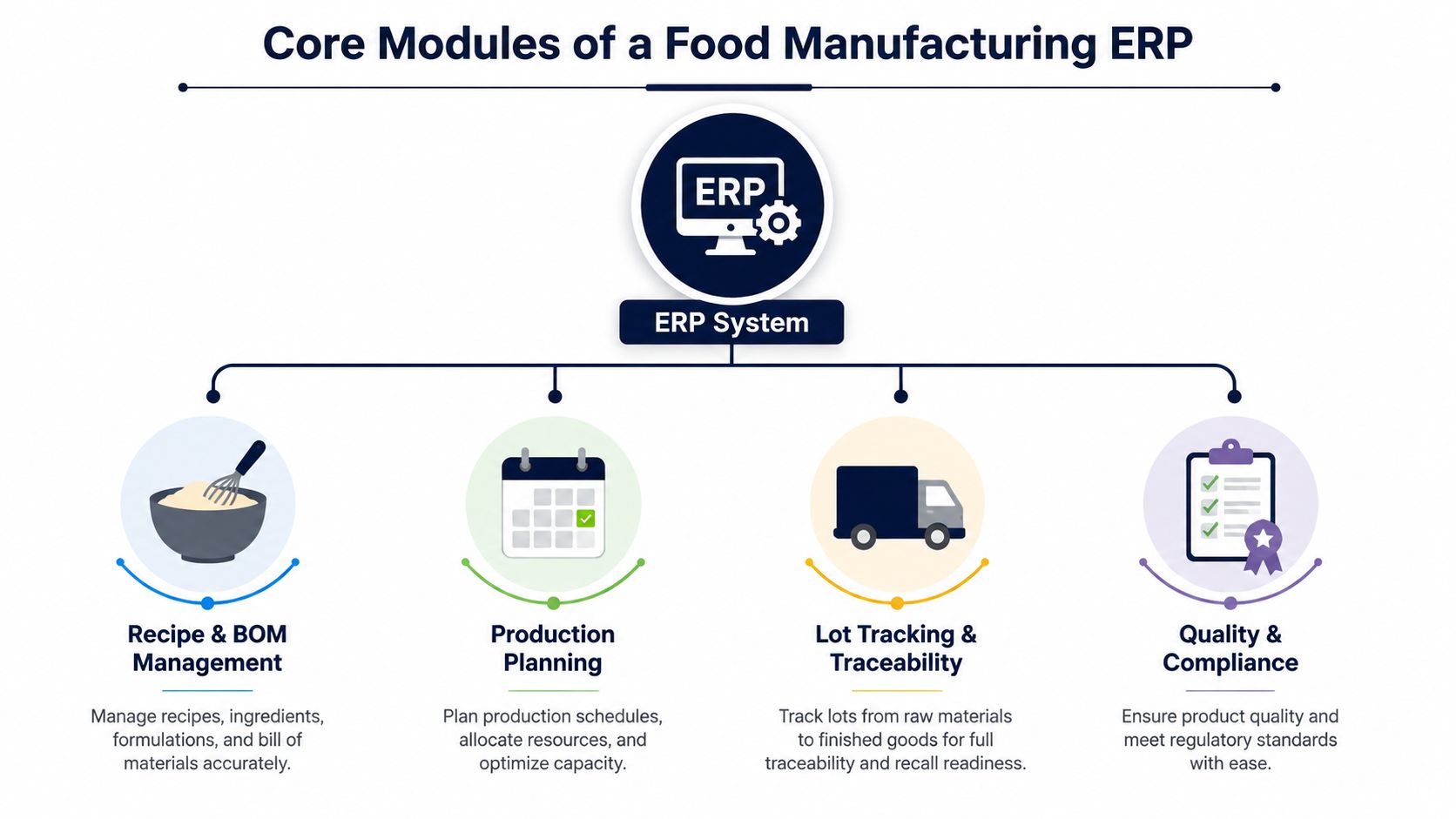
A food ERP pays for itself only when its core modules share the same data. If recipe control sits in one system, quality in another, and inventory in a third, the team ends up reconciling records instead of running the plant. SMEs do not need another stack of disconnected tools. They need one platform that keeps operations and finance on the same page, so a bad batch, a late supplier change, or a traceability gap does not turn into avoidable cost.
Start with recipe and inventory control
Recipes and multi-level BOMs have to accept substitutions without breaking the record. If a supplier delivers a partial load and the team uses an approved alternative ingredient, the system should log the change, reprice it, and keep the batch history intact. Anything less leaves the finance team guessing and the operations team cleaning up after the fact. A food ERP that cannot do this is just a filing cabinet with a login.
FEFO inventory control matters just as much. Aptean's food ERP feature set includes FEFO and expiration date alerts, along with ingredient and allergen management and lot-level traceability (Aptean food ERP). For chilled, frozen, or short-shelf-life products, that is what keeps usable stock moving and helps avoid writing off product that should have shipped.
Quality, traceability, and costing belong in the same flow
Quality control needs hold and release logic so rejected stock does not slip into the wrong order. Lot traceability has to run forward and backward, so you can isolate a supplier lot and show where finished goods went. Costing has to recalculate as soon as yield drifts, because waiting until month-end means the numbers are already stale and the margin is already wrong.
That is why consolidated systems make sense for SMEs. When finance, operations, and sales all read the same record, nobody wastes time re-keying the same batch story into three places. In Zynthoro, the point is to keep recipes, work orders, QC, and cost roll-ups in one workspace so operational data and financial data stay aligned.
A quick vendor checklist
- Recipe governance: Controlled revisions, not loose edits.
- Lot movement: Supplier to batch to shipment, all in one flow.
- Quality holds: Clear block, release, and exception handling.
- Cost visibility: Yield changes should hit margin logic immediately.
The market is already large enough to show where buyers are spending. One report values the food manufacturing ERP software market at US$4.2 billion in 2025, projected to reach US$8.1 billion by 2034 at an 8.3% CAGR. The same source says cloud deployment already held 62.5% of revenue share, while inventory management accounted for US$1.2 billion in 2025 and 28.6% of the market (MarketIntelo). That lines up with what operators care about first, inventory, cloud delivery, and production-linked control.
If you are comparing licensing options, Kickstarter 3 is a factual example worth looking at. The snapshot lists it as €199 one-time, with 75% of Starter and lifetime access, plus accounting and operations, project management, and marketing and content coverage.
EU Compliance, Data Residency, and Audit Readiness
Food SMEs in Europe do not need broad claims about security. They need a system that keeps supplier data, customer records, batch history, and audit trails in a place they can defend to customers and auditors. If the software setup makes compliance harder, it is the wrong stack.
EU-hosted infrastructure changes the conversation
EU-hosted infrastructure matters because it reduces the question of where data sits and who can touch it. For a processor handling orders, supplier contacts, labels, and recall evidence, GDPR-ready controls and role-based access should be standard, not a paid add-on.
Zynthoro is built around that model, with an EU-hosted workspace and consolidated audit logging. That matters because a small team cannot afford to stitch compliance together from five different apps and then hope the records line up during an audit.
Traceability has a practical benchmark
Food audits are unforgiving when records are scattered. Independent guidance on food ERP says around four hours for complete traceability has become an established expectation in audit practice, explicitly codified in BRCGS and often applied by auditors for IFS Food and FSSC 22000 as well (ERP-Software.org). Your ERP has to produce defensible evidence quickly across supplier lots, production batches, and customer shipments.
Rule of thumb: If a recall report takes days to assemble, your system is already behind the standard your buyers expect.
Embedded lot control and digital audit trails matter more than generic document storage. The system should show what went into a batch, what hold was applied, who released it, and where the finished goods went. You do not want someone digging through shared drives while the clock is running.
What to ask any ERP vendor
- Where is the data hosted? Ask for the hosting region, not a marketing phrase.
- Can access be segmented by role? A warehouse user should not see everything finance sees.
- Can you produce traceability evidence fast? Ask them to show it, not describe it.
- Are audit logs unified? Separate logs across tools create holes.
If you only need a light operational setup, the Agency snapshot is a factual benchmark to compare against. It shows how quickly a non-ERP setup stops being enough once food compliance and traceability become central.
Where AI and Automation Actually Pay Off in a Food SME
AI is noisy right now, and most of it doesn't belong in a food plant. A chatbot that answers generic questions won't save a production manager at 6 a.m. when supplier prices changed, a batch is delayed, and the team needs a clean decision before the line starts.
The useful part of AI is narrower. It should remove repetitive glue work, catch exceptions sooner, and keep people out of low-value admin.
Planning and batch work need decision support, not hype
In a food SME, shelf life and supplier lead times matter more than abstract forecasting. If the system can help a planner choose stock that will expire first, or surface the cost impact of a supplier change before the next production run, that's real value. Zynthoro's embedded Claude-powered assistants fit that kind of workflow, where a recipe cost change can surface as soon as a supplier price update hits the record.
Automatic time and cost capture per batch is another practical win. Operators stop filling in scraps of paper, and finance gets cleaner costing without waiting for someone to interpret notes at month-end.
Admin automation is where the hours go
Invoice automation matters because food businesses still waste time reconciling purchase orders to deliveries by hand. That's busywork, and it drags close rates, approval cycles, and cash visibility. When the platform can send, chase, and reconcile invoices from the same system, the team stops firefighting the same transaction multiple times.
Voice also has a place on the floor. A supervisor should be able to log a quality deviation hands-free when their gloves are on and their attention is on the line. That's not futuristic, it's just practical.
Automation should remove the glue between steps, not replace the people making production decisions.
That's the standard I use. If the feature doesn't reduce manual handoffs, shorten cycle time, or prevent a data gap, it's probably just another shiny layer on top of the same old mess.
A useful way to judge any AI feature is simple. Does it help a planner, a buyer, a supervisor, or finance do the next real task faster and with fewer errors? If not, ignore it.
Choosing the Right Vendor Without the Demo Theatre
ERP demos are built to impress people who don't have to live with the software. That's the trap. A vendor can make almost anything look clean for twenty minutes, but the core question is whether the system will survive supplier changes, audit requests, and month-end pressure without creating new admin.
Judge vendors on operational depth
Start with food-specific depth. Does the platform understand recipes, substitutions, lot genealogy, shelf life, and quality holds without custom workarounds? If the answer is no, walk away. You're not buying a generic business app and “adding manufacturing later.”
Then look at integration footprint. A fragmented SaaS stack might look cheaper month to month, but every extra connector creates another failure point and another place where numbers drift. A consolidated platform like Zynthoro reduces that sprawl by keeping finance, operations, sales, production, and compliance inside one data model.
Compare the commercial model, not just the feature list
A lifetime option can change the equation for a bootstrapped SME. When you compare monthly subscriptions against a one-time licence structure, you need to think about the multi-year cost of keeping the lights on, not just the launch price. That's where a consolidated platform can become a consolidation play rather than just another tool.
| Dimension | Fragmented SaaS Stack | Consolidated AI-Native ERP (Zynthoro) |
|---|---|---|
| Data continuity | Data gets re-entered across tools | One workspace, one record set |
| Compliance evidence | Split across apps and exports | Unified logs and role-based access |
| Production visibility | Limited by integrations | Recipes, work orders, QC, and traceability in one model |
| Admin load | More chasing, more reconciliation | Fewer handoffs, fewer duplicate entries |
| Support burden | Multiple vendors, multiple tickets | One platform to manage |
Pressure-test the support model
Ask who answers when production is live and something breaks. Ask how data portability works if you ever leave. Ask whether the vendor can support the business after go-live without turning every change into a paid consulting project.
If a vendor can't answer those questions clearly, they're not ready for an SME that lives or dies on execution.
Implementation, Migration, and the First 90 Days
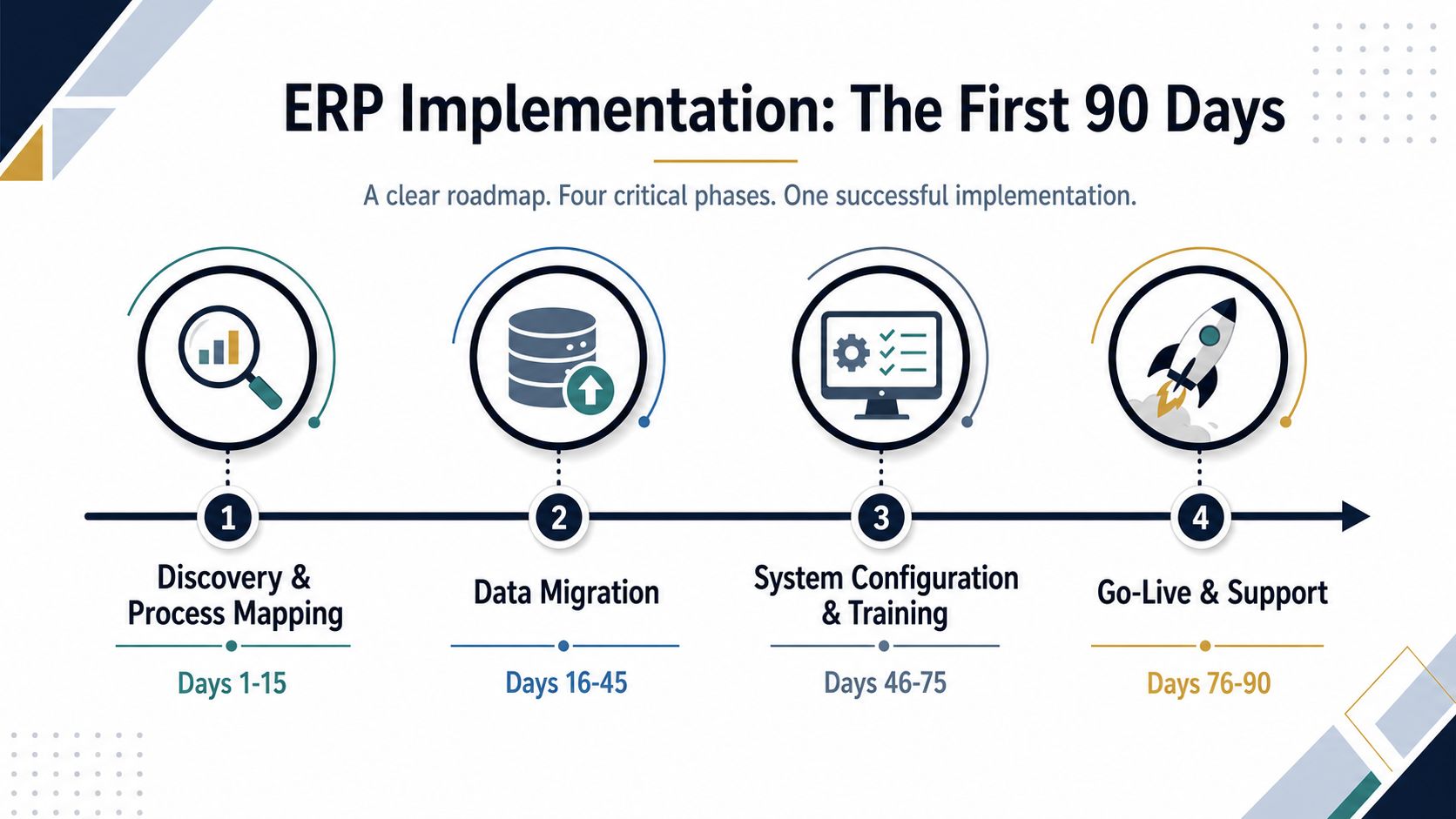
The fastest way to ruin an ERP rollout is to treat go-live like a software install. It isn't. It's a business reset, and the first ninety days decide whether the team adopts the system or avoids using it.
Clean the process before you move the data
Discovery and process mapping come first. You need to agree on how recipes are approved, how lots move, who releases quality holds, and what counts as a finished batch. If you don't settle that before migration, the old confusion gets rebuilt in a new system.
Then migrate the basics. Recipes, suppliers, customers, and opening stock balances need to be cleaned before they enter the new workspace. The source data is usually the slow part, not the software configuration.
Pilot one product line, then expand
A pilot run on one line is the safest move. It exposes the gaps without putting the whole business at risk, and it gives the team a realistic feel for how production, quality, and finance interact in the new system. After that, staged cutover with parallel reporting keeps finance comfortable while the plant learns the rhythm.
Zynthoro's onboarding approach for a food SME should be straightforward, workspace setup first, master data next, then the first batch. That's the right order because the system has to reflect the plant, not force the plant to fit a half-configured tool.
Don't clean master data after go-live. Clean it before. Bad item records spread faster than bad process notes.
That's the mistake I see over and over. Teams want to move fast, so they postpone cleanup. Then they spend the next month fixing the same old errors in a new interface.
ROI, Recall Readiness, and Why Acting Now Matters
ERP in food manufacturing pays off by removing friction where the business loses time and money. Better inventory discipline cuts waste. Better invoicing and reconciliation shorten month-end close. Better batch visibility saves hours that would otherwise go into chasing answers across disconnected tools.
ROI shows up in fewer leaks, not flashy headlines
FEFO inventory control protects margin because expiry discipline stops usable stock from being written off too soon. When the system directs picking toward older stock that can still be used, you waste less and avoid shipping inventory that should have moved earlier. Faster financial close matters for the same reason. Automated invoices and reconciliations reduce manual chasing and keep finance from wasting days on cleanup.
The bigger gain is continuity. Every time staff retype data from one system into another, the risk of an error rises. If that error touches a batch, a shipment, or a customer record, the business pays twice, once in labor and once in risk. That is why disconnected tools cost more than software licences ever show on paper.
Recall readiness is a cash decision
Return to the opening scenario. In a fragmented setup, a recall review can take days because everyone is rebuilding the same story from different files. In a properly implemented ERP, lot lookup should isolate affected batches and shipments fast enough to support a controlled response. For an SME, that separates a manageable incident from a reputation problem.
Food ERP is no longer a niche buy. As noted earlier in this guide, market analysts point to strong demand in inventory, cloud deployment, and production-linked control, which tells you where buyers are putting their money. That matters because it reflects a simple reality. Food SMEs are trying to replace scattered tools with one place where production, compliance, and finance stay aligned.
A food SME does not need another layer of software clutter. It needs one platform that keeps the operational record straight when a customer asks for proof, a buyer asks for traceability, or finance asks why margin slipped on a line. Zynthoro fits that consolidation play, with production management, audit trails, and connected business domains in one EU-hosted workspace.
If you are still stitching recipes, lots, invoices, and quality checks together by hand, stop now. Visit Zynthoro to see how a single, EU-hosted platform can bring food manufacturing data back into one controlled flow. If you want less chasing, faster recalls, and cleaner margin control, start there.