


A customer calls on Monday morning: several units from a recent batch have failed in the field. By lunch, production has paused, the sales team is searching email threads, and someone is opening spreadsheets with names such as QC-final-new2. Nobody can quickly answer which raw-material lots were used, which operator completed the work order, or whether the affected products were shipped to one customer or several.
That situation is common in small manufacturing businesses. The inspection may have happened, but the evidence is scattered across paper forms, shared drives, purchasing records, and personal notebooks. Quality control in manufacturing fails operationally when teams can detect a defect but can't prove what happened next. The practical fix is a connected system that makes inspection, production, disposition, and traceability part of the same workflow.
Table of Contents
- When Quality Control Becomes a Crisis
- Core Quality Control Principles for Small Manufacturers
- Acceptance Sampling Plans That Actually Work for SMEs
- Managing Non-Conformance Reports Without the Paperwork Nightmare
- Integrating Quality Control into Production Workflows
- Traceability Systems That Make Recalls Manageable
- How Zynthoro Consolidates Quality Control Data
When Quality Control Becomes a Crisis
The first instinct is usually to find the defective units. The harder task is identifying the boundaries of the problem.
A small cosmetics producer might know that a cream has the wrong viscosity, but not whether the issue affects one filling run or every product made after a supplier delivery. The raw-material certificate may be in an email. The mixing record may be handwritten. Finished-goods shipments may sit in an inventory spreadsheet that doesn't share lot numbers with production.
That creates a costly chain reaction:
- Production loses time: Staff stop current work to search for records and inspect stock.
- Sales loses confidence: Customer service can't give a clear answer about affected orders.
- Inventory becomes uncertain: Good and questionable lots may be stored together.
- Managers make defensive decisions: Without evidence, they may quarantine far more product than necessary.
- Audits become stressful: The business must reconstruct compliance rather than demonstrate it from controlled records.
The damage isn't limited to returns or rework. A customer who receives inconsistent goods may question every future shipment. An auditor may focus on missing evidence even when the underlying process was sound. Suppliers may dispute responsibility because nobody can show which material lot entered the batch.
Practical rule: A quality record should answer who checked what, against which standard, when, and what happened after the result.
The history of quality control points toward this approach. Statistical quality control began taking shape in the 1920s, when sampling theory helped manufacturers move beyond relying mainly on end-of-line inspection and toward measuring variation during production, as documented by the National Institute of Standards and Technology. Later methods such as control charts and process capability analysis gave teams ways to separate normal process behavior from unusual causes.
The same process orientation shaped ISO 9001. The standard launched in 1987, grew from the UK's BS 5750, and shifted quality management toward controlling processes rather than only checking finished goods. Its 1994 revision emphasized preventive action, while the 2000 revision consolidated earlier versions into a process-focused standard. By the 2020s, more than 1 million organizations worldwide had achieved ISO 9001 certification, according to the BSI history of ISO 9001.
For an SME, that doesn't mean building a bureaucracy. It means designing a practical record trail before the next complaint arrives.
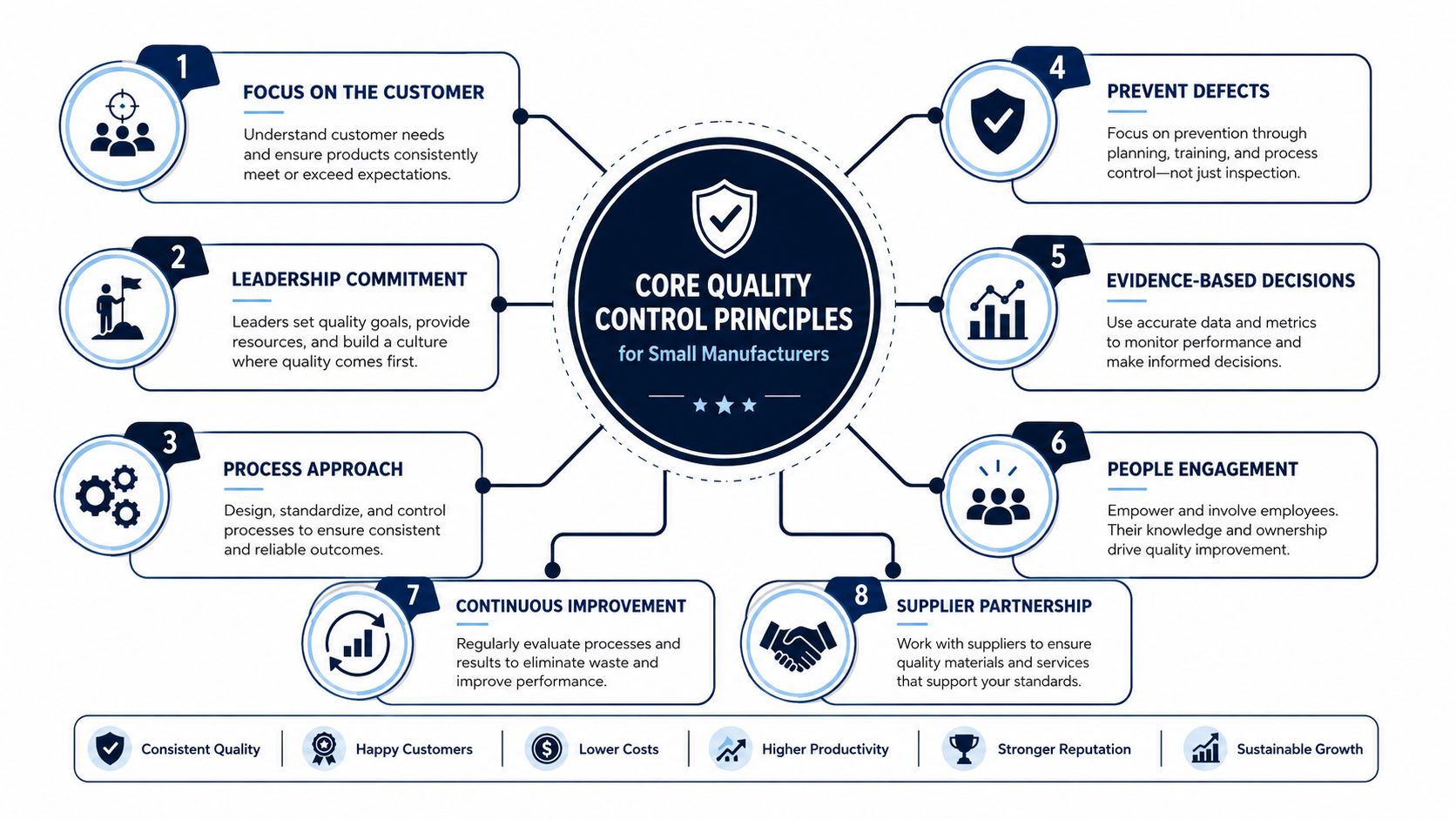
Core Quality Control Principles for Small Manufacturers
Start with the product characteristics that matter most to customers and regulators. Define the measurement, the acceptable range, the inspection point, and the person responsible. A checklist that says “check packaging” is weak. A useful instruction identifies the seal condition, the label version, the measurement method, and the pass or fail rule.
Control the process, not only the output
End-of-line inspection tells you that something is wrong after material, labor, and machine time have already been committed. Process-based control looks earlier.
A food manufacturer, for example, might monitor mixing temperature during production rather than waiting for a final product test to reveal inconsistent texture. A light manufacturer may check a critical dimension after setup, then at planned intervals while the machine is running. These checks create opportunities to correct drift before an entire lot is affected.
Statistical process control, or SPC, makes this practical. Operators record a measurement over time and use a control chart to see whether the process behaves consistently. Normal fluctuation is common-cause variation. A sudden tooling change, incorrect setting, contaminated ingredient, or damaged sensor can create special-cause variation that deserves investigation.
Consider packaging weight. If weights move around the established process average in a stable pattern, changing settings after every reading may create more instability. If the readings shift suddenly after a material change, the team should investigate the material, setup, and measurement method instead of treating the issue as routine noise.
Cosmetic consistency follows the same logic. A gradual change may point to normal equipment behavior or a formulation characteristic. A sudden viscosity shift may indicate an ingredient lot, mixing sequence, temperature, or operator action that differs from the validated process.
Apply ISO thinking without copying large-company complexity
ISO 9001's useful lesson for a small operation is not the volume of paperwork. It's the discipline of defining processes, responsibilities, inputs, outputs, and corrective action.
A workable SME system should make it easy to:
- Define requirements: Store product specifications and customer requirements with the relevant product version.
- Control changes: Record changes to recipes, bills of material, tooling, suppliers, and inspection criteria.
- Capture evidence: Link results to a work order, batch, lot, or shipment.
- Review failures: Record the non-conformance, disposition, root cause, and follow-up verification.
- Protect records: Keep an audit trail so staff can't overwrite an earlier result.
The best system is the one operators will use during a busy shift. If recording a check requires duplicate entry in three tools, the process will eventually become incomplete.
Acceptance Sampling Plans That Actually Work for SMEs
Acceptance sampling is the sensible middle ground between inspecting every unit and accepting a lot without evidence. The inspector selects a sample, counts defects or nonconforming items, and accepts or rejects the lot against a defined plan.
AQL, or acceptance quality limit, turns a general expectation into an operating rule. An AQL of 1% means that, under an ISO 2859-style plan, the stated acceptance criterion treats no more than one defective item per 100 as acceptable in the lot, as explained in this ISO 2859-1 AQL overview. It doesn't mean every possible sample will contain exactly that ratio, and it isn't permission to choose convenient items. ISO 2859-1 requires simple random sampling, so the sample must represent the lot rather than the inspector's preferred pieces, as stated in this published ISO 2859-1 document.
Choose the plan by risk
Use tighter controls where failure could create a safety, regulatory, or major functional issue. A critical pharmaceutical component, a food seal, or a load-bearing part deserves more protection than a low-risk promotional insert. For a known unstable supplier or a process with recent failures, increase inspection intensity temporarily and return to a normal plan only after evidence supports the change.
ISO 2859-1 supports single, double, and multiple sampling plans. A single plan gives one clear decision. A double plan allows a second sample when the first result is inconclusive. Multiple plans can reduce inspection effort in suitable situations, but they require disciplined execution and clear records.
The following is an operational illustration, not a replacement for selecting the applicable ISO code letter and acceptance numbers for your product and risk profile. The sample size and thresholds must come from the chosen standard plan.
| Batch Size | Risk Level | AQL % | Sample Size | Accept/Reject Threshold |
|---|---|---|---|---|
| Small batch | Critical | 1% | Select from the applicable ISO plan | Use the documented critical-limit rule |
| Medium batch | Moderate | 1% | Select from the applicable ISO plan | Accept or reject against the recorded limit |
| Large batch | Low | 1% | Select from the applicable ISO plan | Use the approved lot decision rule |
ISO 2859-2:2020 defines acceptance sampling by attributes indexed by limiting quality, or LQ. The standard says consumer risk at the LQ is usually below 10%, except in some instances, according to the ISO 2859-2 standard page. That protection depends on the chosen LQ and random sample selection.
Document the product, lot size, inspection level, code letter, AQL or LQ, sample method, sample size, acceptance number, rejection number, inspector, date, and final decision. Zynthoro can centralize those records alongside purchasing, inventory, and production. For teams evaluating a lightweight entry point, Kickstart 1 is listed at €79 one-time, with lifetime access, AI Assistants, 50 credits/month, Planning & Time Tracking, a Communication module, and Canva Studio.
Managing Non-Conformance Reports Without the Paperwork Nightmare
An NCR should help a team make a controlled decision, not become a long narrative that nobody finishes. Record the defect in plain language, identify the affected material or product, place questionable stock on hold, and attach the evidence needed to support the decision.
A useful NCR contains:
- Identity: Product, batch or lot, work order, supplier, and discovery point.
- Condition: What failed, the measured result, the requirement, and supporting photo or test record.
- Containment: Quantity isolated, location, shipment status, and people notified.
- Disposition: Rework, scrap, use-as-is with approval, or return to supplier.
- Action: Owner, due date, root cause, corrective action, and effectiveness check.
Make the disposition explicit
Suppose a cosmetics batch has incorrect viscosity. The team shouldn't just adjust the mixture and release it. First, quarantine the affected batch. Then compare the result with the specification, check the ingredient lot, confirm the mixing sequence and temperature record, and decide whether approved rework is technically and legally acceptable.
A food producer facing seal failures may need to stop shipment, inspect the relevant packaging materials, verify the sealing equipment settings, and determine whether the failure began after a changeover. The disposition might be rework, additional inspection, or rejection. The decision needs an approver and a record.
Find causes that can be fixed
The 5 Whys works when the team asks factual questions rather than assigning blame. A fishbone diagram helps organize possible causes across people, equipment, materials, methods, measurement, and environment. Pareto analysis helps identify which recurring defect categories deserve attention first.
The corrective action must address the cause, not only the visible defect. Replacing a failed seal is containment. Correcting the sealing temperature control, maintenance trigger, work instruction, or packaging specification may be the corrective action.
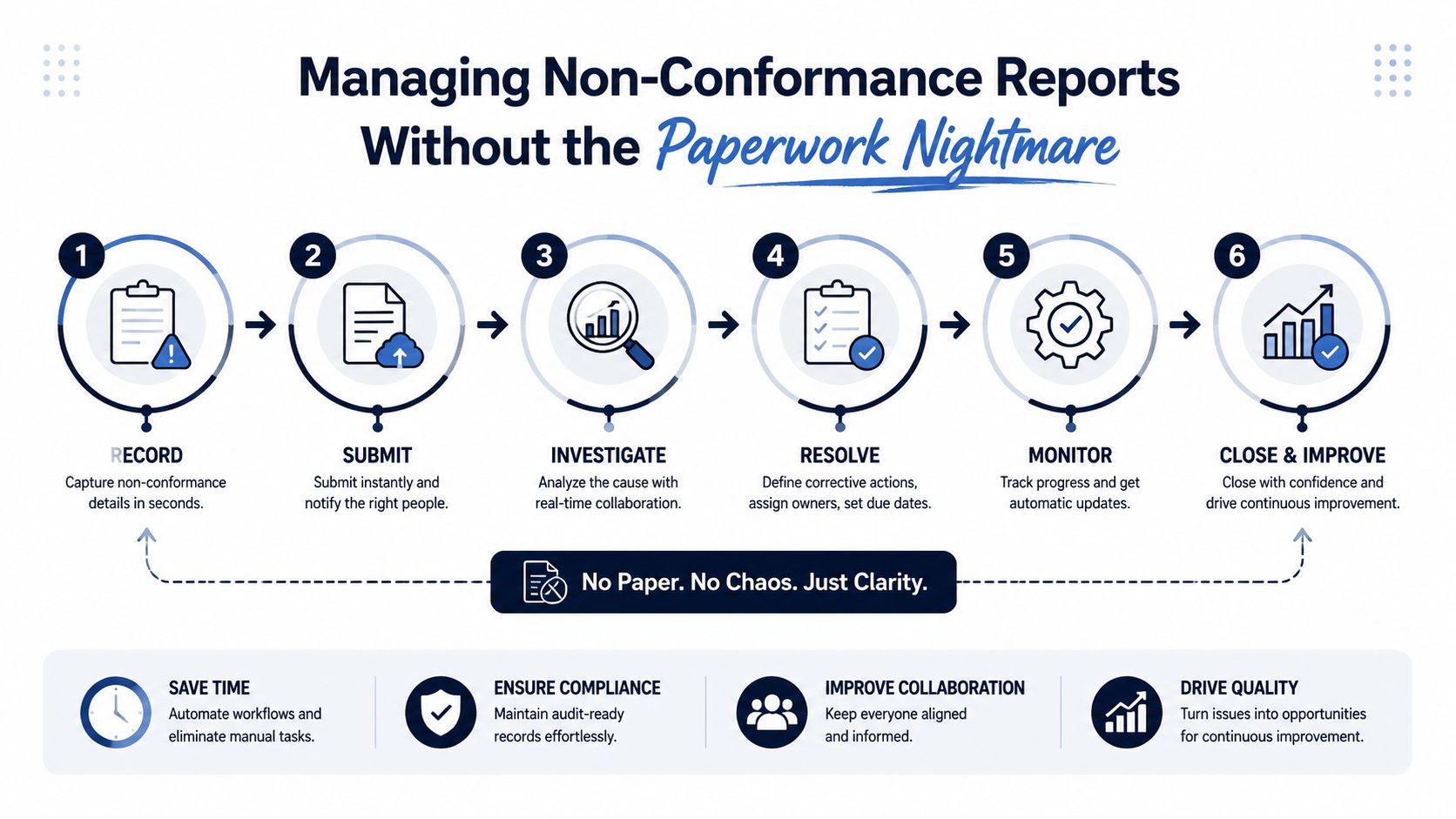
Close the NCR only after verifying effectiveness. Review a subsequent run, confirm the measurement, and record whether the defect returned. Digital workflows can keep ownership and evidence visible without forcing operators to maintain separate paper files. For contrast, Agency is cataloged as a full non-ERP suite for agencies and multi-client teams at €1,199/mo, with accounting, inventory, project management, marketing, five company workspaces, and 25 users.
Integrating Quality Control into Production Workflows
Quality control shouldn't appear as a gate that production must fight through. It should sit at the points where a decision is cheapest and most useful.
A practical manufacturing flow has three layers:
- Incoming inspection: Confirm that raw materials, components, packaging, and supplier documents meet requirements before release to production.
- In-process checks: Verify critical settings and characteristics while the batch or work order is still active.
- Final inspection: Confirm finished-goods requirements, labeling, quantity, packaging, and release status before shipment.
The right balance depends on risk and process stability. A critical safety feature may justify 100% inspection. A stable, low-risk component may suit random acceptance sampling. A newly introduced supplier or changed process may need temporary additional checks until the team has evidence that the new arrangement behaves consistently.
Make the records travel with the work
An incoming inspection result should connect to the supplier lot and purchase record. An in-process result should connect to the work order, operator, equipment, and product version. A final release should connect to the finished lot and shipment decision.
That connection matters during scheduling. If a raw-material lot is on hold, planners shouldn't allocate it to a work order as if it were available. If a work order fails an in-process check, inventory and delivery commitments should reflect the hold. If a supplier repeatedly sends nonconforming material, purchasing should see the pattern rather than treating every failure as an isolated production problem.
Share responsibility on the floor
Operators need clear criteria and authority to stop or hold questionable work. Quality staff should define standards, review trends, and support investigations, but they shouldn't be the only people allowed to notice defects.
Use short checklists at the workstation, consistent measurement methods, and shift handover notes that identify open issues. Keep the evidence close to the action. A worker who can record a result against the active work order is less likely to write it on a scrap of paper for later entry.
The goal isn't maximum inspection. It's controlled release at the right points, with enough connected evidence to make production, purchasing, inventory, and customer decisions from the same facts.
Traceability Systems That Make Recalls Manageable
Traceability is often treated as compliance administration until a customer reports a field problem. Then it becomes the difference between a targeted investigation and a broad, expensive recall.
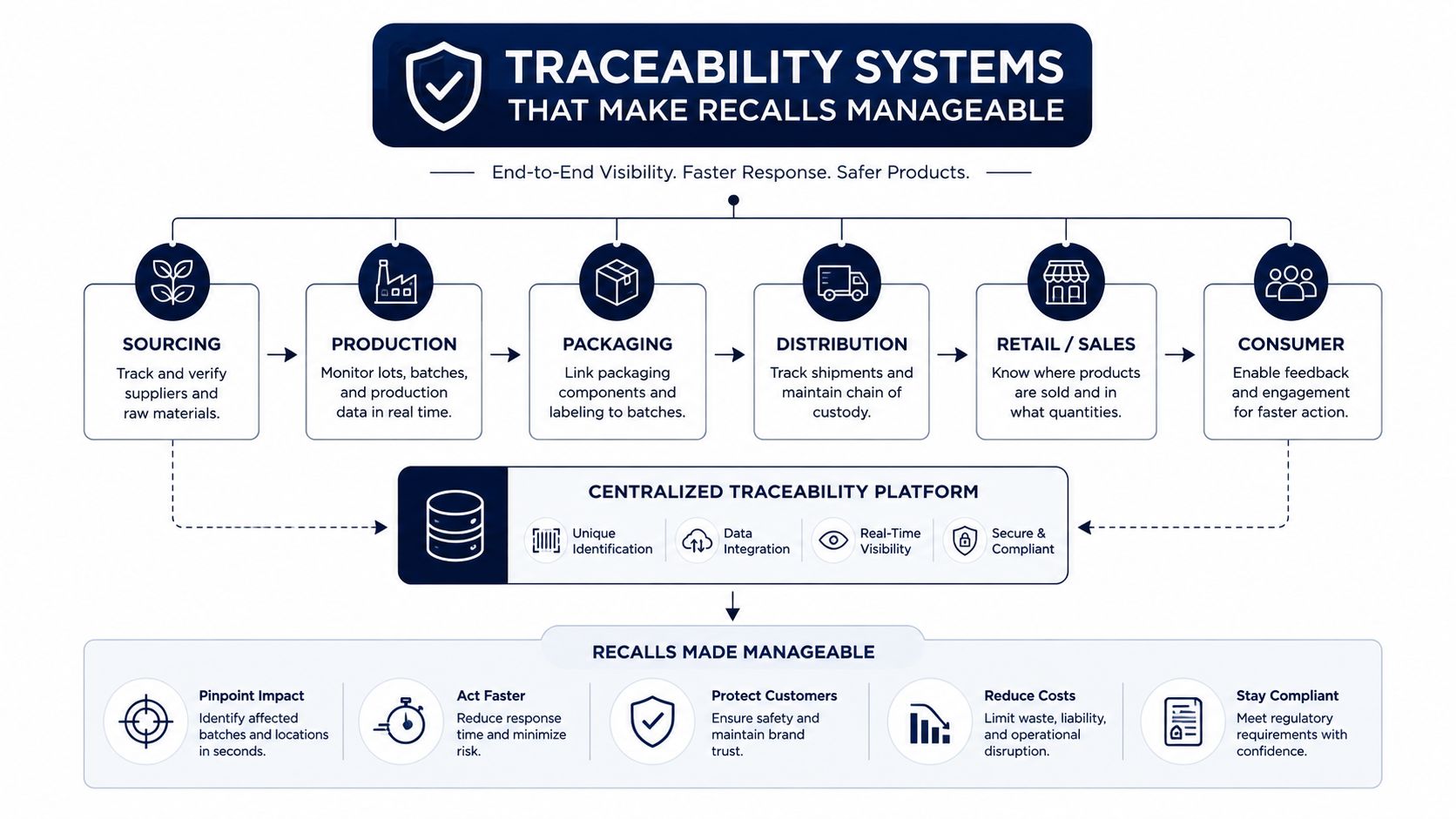
For food, cosmetics, pharmaceuticals, and other lot-sensitive operations, the record chain should run in both directions:
Supplier material lot → production batch → finished-goods lot → customer shipment
If a finished product fails, the team should be able to move backward to the ingredients, components, equipment, and work order involved. If a supplier reports a contaminated or defective material lot, the team should be able to move forward to every finished batch and shipment that used it.
The practical consequences are significant. One industry source reports recall precision of only 5–15% without traceability, meaning that only a small share of recalled items may be faulty when records can't isolate the affected population, as described by CSP recall management guidance. That figure makes lot-level records more than an audit preference. They reduce unnecessary disruption for customers and protect usable stock from being swept into a precautionary recall.
Build a usable chain of evidence
A small manufacturer doesn't need to record every possible detail. It does need consistent identifiers and links:
- Materials: Supplier, material lot, receipt, status, and inspection result.
- Production: Recipe or specification version, bill of material, work order, equipment, and batch.
- Quality: Measurements, sampling plan, non-conformance, approvals, and release status.
- Distribution: Finished lot, customer order, shipment, and delivery destination.
- Change history: Who created, approved, amended, or released each relevant record.
This structure also accelerates root-cause analysis. If several customer complaints point to the same finished lot, the team can compare shared materials and process conditions. If failures cross several finished lots but share one supplier lot, the investigation moves toward incoming material rather than randomly retesting every product.
The documentation burden is real. Industry reporting says manufacturers spend an average of 15 days preparing for shop-floor audits and 13 days for quality audits each year, with cost of quality among the most commonly tracked KPIs, according to Deltek's 2026 manufacturing reporting. A connected traceability system reduces the reconstruction work by creating records during the operation instead of asking staff to recreate them later.
How Zynthoro Consolidates Quality Control Data
Disconnected tools create the proof gap. Zynthoro's production management module brings recipes, multi-level bills of material, work orders, quality control checks, lot traceability, and cost roll-ups into one production environment for food, cosmetics, pharma, and light manufacturing.
The implementation principle is straightforward. Start with the product master, then connect each production activity to that controlled definition.
Build the record around the work order
Store the product recipe and BOM version with the work order. Attach incoming material lots as they are received and released. Record inspection results against the relevant work order or batch rather than keeping a separate spreadsheet that someone must reconcile later.
For acceptance sampling, keep the AQL target, sampling method, sample size, and accept or reject threshold with the product or inspection plan. When an inspector completes a check, the result should update the lot's status and remain available for review.
Zynthoro can also maintain audit trails for compliance and generate traceability reports that connect raw materials, production batches, finished goods, and customer shipments. That gives a manager a practical answer to the recall question: which products are affected, where are they, and which customers received them?

Reduce admin without hiding decisions
Embedded AI assistants can help organize quality documentation and analysis, while people remain responsible for approvals, dispositions, and release decisions. Operators can use hands-free voice input where suitable, which may help capture observations without leaving the production task, but the workflow still needs defined fields and review controls.
The platform's EU-hosted infrastructure, GDPR-ready controls, role-based access, and audit trails address the governance concerns that arise when production and quality data are centralized. The broader value is operational: purchasing, inventory, production, quality, finance, and customer records can use the same underlying data instead of forcing a small team to maintain parallel versions.
A useful AI adoption principle is to start with a narrow workflow. A 2026 cross-survey view reports 47% of manufacturers using AI in quality processes, while only about 10% deploy it at scale, and the same reporting cites high implementation cost as a major barrier, according to iFactory's AI quality trends reporting. For an SME, documentation assistance, recurring-defect analysis, or supplier-risk review is usually easier to govern than attempting to automate every inspection at once.
Zynthoro connects production recipes, BOMs, work orders, QC checks, and lot traceability so your team can replace scattered records with an audit-ready workflow. Visit Zynthoro to see how a unified platform can make quality control in manufacturing easier to run, investigate, and prove.