


You're trying to close a deal while doing finance's job. A quote is due before lunch, a customer wants last month's invoice, and your team is switching between a CRM, quoting tool, inventory spreadsheet, accounting app, and bank portal. Everyone is busy, yet nobody has one reliable answer to a simple question: what happened between the quote and the cash?
That gap is where SMEs lose capacity. A rep retypes an order, an administrator checks a price, finance corrects an invoice, and someone later matches a bank payment by hand. The losses rarely look dramatic. They appear as delayed follow-ups, duplicated records, small errors, and customers waiting for documents.
Sales and administration should remove that leakage, not create more of it. The practical answer is to connect quotes, orders, pipeline, invoices, and reconciliation in one auditable flow, with AI handling routine data work and people reviewing the exceptions.
Table of Contents
- The Daily Admin Spiral Most SMEs Are Stuck In
- What Sales and Administration Really Means in 2026
- The Five Core Capabilities That Hold It All Together
- Where AI Does the Heavy Lifting
- A Real Day in a Connected Quote-to-Cash Workflow
- EU E-Invoicing and Compliance Without the Headache
- Why Consolidation Beats Another Subscription
- What to Measure in Your First 90 Days
The Daily Admin Spiral Most SMEs Are Stuck In
At 10:15, the founder of a 12-person distribution business opens a CRM to check the pipeline. A customer has requested a quote for several products, but the latest price list is in a separate quoting tool. Stock availability sits in a spreadsheet, while VAT details live in the accounting application.
At 10:42, the founder copies the customer information across, attaches the quote, and sends it from the wrong email address. The customer replies with a correction to the delivery address. That message stays in the inbox while the founder answers a call about an overdue invoice.
By the afternoon, the accepted quote still hasn't become an order. The warehouse is working from an email, finance is waiting for a document, and the customer assumes the delay means the business is disorganised. The invoice eventually arrives from another system, and the payment gets matched to the wrong customer record before somebody fixes it.

The leakage is operational, not dramatic
Disconnected sales and administration rarely causes one spectacular failure. It creates small, repeated interruptions:
- Duplicate entry: Customer, product, price, and tax data get typed into several tools.
- Unclear ownership: Sales assumes finance has invoiced, while finance assumes sales has confirmed the order.
- Stale information: A spreadsheet shows stock or pricing that no longer matches the operational record.
- Slow approvals: Managers chase messages instead of approving a quote or purchase in context.
- Weak visibility: The pipeline says a deal is likely, but nobody knows whether delivery, invoicing, or payment is ready.
That's why adding another point solution usually disappoints. It may improve one task while leaving the hand-off broken. A faster quoting tool doesn't solve an order that still needs manual entry. A better accounting app doesn't solve a sales record with missing delivery details.
Practical rule: Measure the hand-offs, not just the tools. Every time a person copies information from one system to another, you've found a candidate for consolidation or automation.
The rest of the problem is straightforward to diagnose. Follow one deal from opportunity to quote, from quote to order, from order to invoice, and from invoice to reconciled payment. Wherever the record changes hands, capacity leaks. Sales and administration becomes valuable when those transitions happen inside one connected workflow.
What Sales and Administration Really Means in 2026
A customer accepts a quote, but the order still waits in someone's inbox. Finance creates an invoice from a different record, then matches the payment against a spreadsheet. That gap between quote, order, invoice, and reconciliation is where SME capacity disappears.
Sales and administration covers the operating work that turns an opportunity into paid, reconciled revenue: opportunity tracking, quoting, order entry, customer records, invoicing, VAT handling, payment matching, reporting, and document control. The job is to preserve one accurate commercial record as responsibility moves from sales to operations and finance.
The need for a shared record shaped modern business software. Material requirements planning emerged for large manufacturers in the 1960s. Manufacturing resource planning expanded the model in the 1980s, and enterprise resource planning became a standard architecture in the 1990s, bringing accounting, sales, HR, procurement, and other functions into integrated systems. The history and SME context are outlined in Canada's small-business statistics resource.
By the 2010s, ERP vendors were processing operational data in real time. In the 2020s, AI became embedded across ERP platforms to support proactive decisions. That progression matters because sales administration now belongs with finance and operations, not in a separate collection of disconnected apps.
Follow the revenue, not the department chart
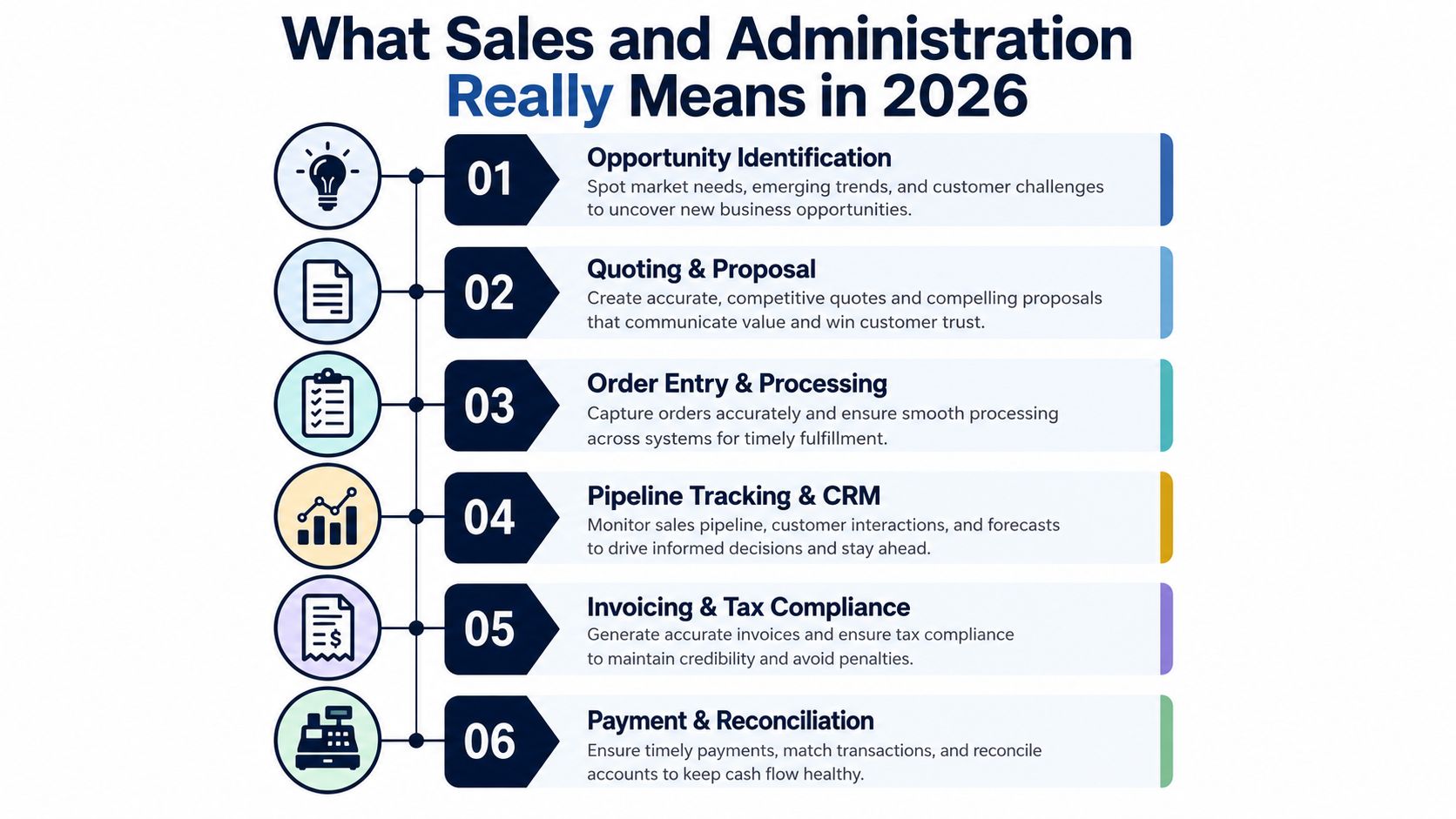
Trace one commercial record through six connected stages:
- Opportunity identification: A prospect or existing customer creates a commercial possibility.
- Quoting and proposal: The business sets scope, products, pricing, terms, and tax treatment.
- Order entry and processing: Acceptance becomes an executable order for operations and fulfilment.
- Pipeline tracking and CRM: The team records stage, value, probability, ownership, and next action.
- Invoicing and tax compliance: The business issues the correct document with the required financial data.
- Payment and reconciliation: Finance matches the incoming payment and closes the commercial loop.
SMEs operate at the centre of this flow. In Canada, small and medium-sized enterprises accounted for 48.0% of output value added in 2021, while the 2024 update recorded small businesses contributing 34.4% of private-sector GDP. In the UK, SMEs represent around 60% of employment and half of turnover. In the United States, small businesses represent 99.9% of businesses and employ 61.7 million people, nearly half of the private-sector workforce, as summarised in this ERP business-process overview.
Use that scale to set the right standard: sales and administration should make revenue easier to audit, fulfil, invoice, and collect. An AI-native ERP such as Zynthoro collapses the hand-offs into one connected flow, so each team works from the same record and exceptions remain visible.
The Five Core Capabilities That Hold It All Together
A connected sales and administration flow needs five capabilities. They aren't separate feature categories. They're five stages of the same commercial record.
Quotes start with trusted data
A quote should draw from current customer details, product information, pricing, availability, and tax rules. If an administrator has to check five places before sending it, the business has already introduced delay and risk.
The practical standard is simple: draft quickly, validate automatically, and preserve the version that the customer accepted. That quote should then become the source for the order.
Orders should inherit acceptance
Order entry is where many SMEs create unnecessary rework. Staff copy line items, quantities, addresses, discounts, and delivery terms from an accepted quote into another screen or spreadsheet.
A connected system turns an accepted quote into an order without rekeying. Operations sees what was sold, finance sees what should be billed, and sales can track fulfilment without asking three colleagues for updates.
Pipeline needs operational context
A pipeline is more than a list of opportunities. It should show weighted value, deal age, owner, next action, customer history, and order status in one view.
For context, overall lead-to-closed-deal conversion commonly sits around 15% to 30%, while enterprise sales often fall around 10% to 15% and transactional sales around 25% to 40%, according to Bigin's sales pipeline tracking benchmarks. Use those ranges as a sense check, not as a target detached from your sales motion.
Invoicing must carry compliance
Invoices shouldn't require a separate export and manual rebuild. The system should reuse the order, customer, VAT, payment terms, and delivery information. For EU operations, it also needs to support structured electronic invoicing and changing national requirements.
Reconciliation closes the loop
A sale isn't administratively complete when the invoice is sent. Finance needs to match the bank transaction, identify partial or combined payments, flag anomalies, and close the record.
| Capability | Typical SME Pain Point | Connected ERP Outcome | Zynthoro Module |
|---|---|---|---|
| Quotes | Prices and customer details are copied between tools | Validated quotes use shared commercial data | Sales Administration |
| Orders | Accepted quotes are manually re-entered | Quotes convert directly into executable orders | Sales Administration |
| Pipeline | Forecasts lack fulfilment and finance context | Deal value, stage, action, and status stay connected | Sales Administration |
| Invoicing | Separate billing creates missing fields and rework | Orders provide the source data for invoices | Invoicing & Finance |
| Reconciliation | Bank matching waits for manual review | Payments are matched against open commercial records | Invoicing & Finance |
Zynthoro's Sales Administration and Invoicing & Finance modules are designed around that shared data model. A status change in one stage can flow through the quote-to-cash chain instead of forcing another person to update another system.
For a smaller setup that needs finance, invoicing, the sales module, and an AI photo/video suite, Kickstarter 2 is listed as a €149 one-time option with 150 credits per month and lifetime access.
Where AI Does the Heavy Lifting
A customer email becomes a quote, the approved quote becomes an order, and the order becomes an invoice. If each hand-off requires retyping, the margin leaks through errors, delays, and reconciliation work. AI earns its place by preserving context across that chain, not by adding another chat window.
Independent sales-automation analysis reports that only 25% of businesses have adopted any form of sales automation, although 30% to 40% of sales tasks are automatable, according to the sales order automation guide from Infrrd. The source also reports potential savings of about 6 hours per sales representative per week, order-processing reductions of 60% to 80%, and accuracy above 96% in automated workflows.
Start with the points where staff copy information:
- Quote drafting: Zyntha turns structured notes or bullet points into a draft quote for review.
- Order-line extraction: A forwarded customer email supplies candidate products, quantities, and delivery details.
- Invoice descriptions: Prior deal context suggests consistent descriptions while a person approves the final document.
- Payment matching: Incoming payments are matched to open invoices, with unusual amounts or references sent for human review.
Invoice automation benchmarks in Rossum's invoice automation analysis show processing costs falling from $6.20 to $1.83 per invoice between the lowest and highest maturity environments, and from $3.03 to $1.45 with end-to-end automation. The practical lesson is direct: capture, routing, validation, and exception handling cost less than repeated manual entry.
| Admin Task | Manual Effort (mins) | With Zyntha AI (mins) | Typical Saving |
|---|---|---|---|
| Drafting a quote from customer notes | Variable | Review required | Less manual composition |
| Entering order lines from an email | Variable | Review required | Less rekeying |
| Matching an invoice to a payment | Variable | Review required | Fewer manual checks |
| Investigating an unusual transaction | Variable | Human decision | Attention focused on exceptions |
Use the table as a measurement framework, not a promise. Record your baseline before switching, then compare the time spent preparing and correcting each transaction.
Halo AI's CRM automation insights provide wider context on CRM automation. The same rule applies to sales administration: AI suggestions become reliable when customer, order, invoice, and payment records share one auditable context.
Zynthoro's embedded assistant, Zyntha, works inside the workflow rather than as a standalone chatbot. If you are evaluating a creative-focused plan separately, Creator is listed at €699 per month with AI video, AI photo, funnels and landing pages, one company workspace, three users, three emails, unlimited aliases, and no ERP.
A Real Day in a Connected Quote-to-Cash Workflow
At 08:30, the owner of a 12-person distribution SME opens Zynthoro's pipeline view. The screen shows active opportunities, recent customer activity, deal owners, and next actions in one workspace. Zyntha flags a stale opportunity and suggests reviewing the last customer message before deciding whether to follow up or close it.

At 09:10, a customer sends a request with product names, quantities, and a delivery requirement. The administrator forwards it into the workspace. Zyntha proposes line items using catalogue and deal history, while the user checks pricing, customer details, delivery terms, and VAT treatment before sending the quote.
At 09:35, the customer accepts. The administrator converts the quote into a sales order, rather than rebuilding it. The order carries the agreed lines and customer information into the operational workflow, where stock and fulfilment status remain visible to the relevant team.
One record follows the transaction
At 11:20, the order reaches invoicing. The invoice inherits the data already approved, so finance doesn't have to retype the customer address or order lines. The user checks the document, sends it through the connected channel, and keeps the invoice attached to the originating customer and order.
The practical reason to connect CRM and accounting is covered well in this guide to CRM accounting sync. The important test is whether the system preserves one commercial context instead of creating another isolated record.
At 15:40, the finance inbox receives a SEPA payment. Zyntha identifies a likely match against the open invoice, checks the reference and amount, and presents the proposed reconciliation. Finance approves the match, closes the invoice, and retains the audit trail.
For a visual sense of how this kind of workspace can be presented, the following video complements the dashboard example without replacing the need to validate your own process.
The owner's end-of-day question is no longer, “Who has the latest version?” It becomes, “Which exceptions need my attention?” That's the difference between administering transactions and supervising a connected flow.
EU E-Invoicing and Compliance Without the Headache
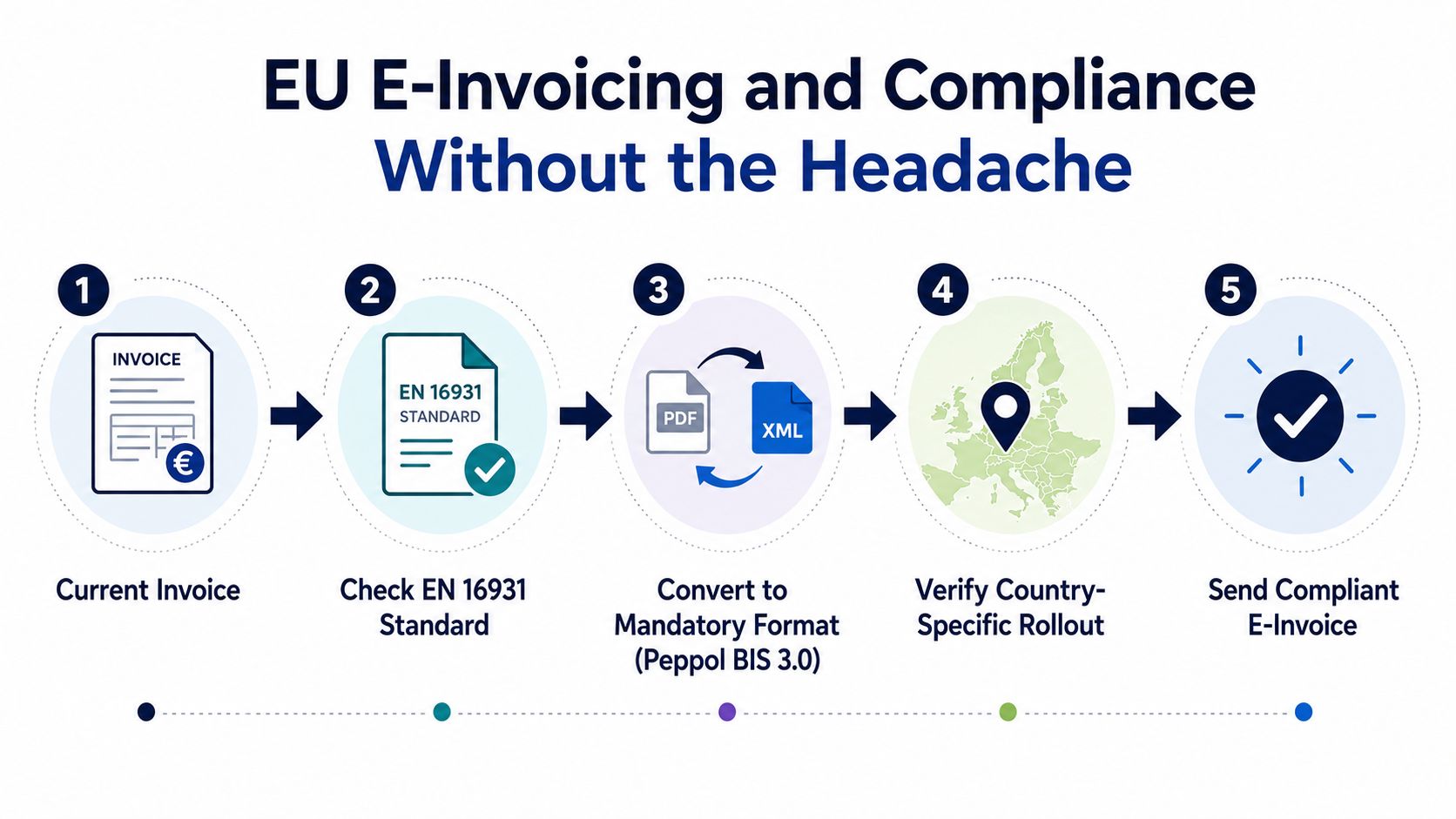
A PDF can look correct and still fail the requirements for automated validation. EU compliance depends on the data behind the invoice, not its visual layout. The EN 16931 standard defines a common machine-readable structure, while each country sets when and how businesses must issue electronic invoices.
For an SME, the practical test is simple: can the workflow carry the accepted quote and order data into an invoice without retyping? Customer and supplier identities, VAT details, invoice dates, line items, totals, payment terms, currency, tax information, and relevant references should remain structured throughout the transaction.
Put the checks inside the quote-to-cash flow
Start with the accepted quote and sales order. Validate the required customer, VAT, line, currency, payment, and tax fields before the invoice leaves the system. Then generate the applicable machine-readable document, apply the country rule for the customer and transaction route, and retain the invoice, approvals, related documents, and payment record together.
That sequence turns compliance into an auditable hand-off rather than a finance clean-up task. It also gives sales administration one record to correct when an invoice fails validation.
EU electronic invoices have the same legal standing as paper invoices, and businesses can generally issue them when the recipient accepts them. Public administrations must accept structured electronic invoices for business-to-government transactions, according to guidance on EU electronic invoicing.
Germany demonstrates why country rules belong in the workflow. E-invoicing became the default issuing method there on 1 January 2025, with full transition required by 2027, as explained in Vertex's EU e-invoicing and VAT compliance guidance.
Zynthoro's EU-hosted, GDPR-ready environment keeps invoicing, VAT handling, audit trails, and role-based access with the same operational record. Configure those checks while the quote becomes an order and invoice. Adding them after reconciliation has already exposed errors is the expensive option.
Why Consolidation Beats Another Subscription
Most SMEs don't have a software problem. They have a handoff problem.
A typical stack might include a CRM, quoting tool, order-management system, invoicing application, payment gateway, reconciliation spreadsheet, expense tracker, and reporting tool. For a company with 10 to 50 people, that can mean 8 to 15 active subscriptions, each with its own login, permissions, pricing model, data export, and failure mode.
The first cost is visible. You pay for seats, modules, integrations, and support. The larger cost is operational. Your team spends time checking whether systems agree, fixing duplicates, and explaining why the dashboard doesn't match the bank.
Consolidation gives the owner three things
Predictable cost matters because SMEs can't plan around a maze of add-ons. A connected ERP gives you a clearer view of what the operating system costs and which workflows it covers.
End-to-end visibility matters because pipeline value is only useful when you can connect it to orders, fulfilment, invoices, and payments. One data model lets the owner inspect the transaction without requesting exports from sales and finance.
Lower data exposure matters because every additional vendor can handle some portion of customer or financial information. Fewer systems reduce the number of integrations and access points that need governance.
Zynthoro brings Sales Administration, Invoicing & Finance, accounting, operations, compliance, and other business domains into one EU-hosted workspace. The point isn't to collect features. The point is to preserve context from the first customer interaction through the final reconciliation.
AI makes this argument stronger. An assistant can't reliably recommend a next action if the latest customer message is in one tool, stock is in a spreadsheet, the invoice is elsewhere, and payment status sits in a bank portal. Connected context is the prerequisite for useful automation.
Keep specialist tools only when they perform a unique job. Cut duplicate records, redundant reports, and integrations that exist only because your systems can't share the same transaction.
What to Measure in Your First 90 Days
Don't judge a new sales and administration system by how polished the dashboard looks. Judge it by whether the quote-to-cash chain becomes faster, cleaner, and easier to audit.
Set a baseline before migration, then review these measures at 30, 60, and 90 days:
- Quote-to-cash cycle time: Record the time from customer confirmation to paid and reconciled revenue. The relevant ERP guidance says the quote-to-order conversion lag should be measured until the order appears in ERP, and delays beyond 24 hours can create working-capital drag and delay invoicing, according to quote-to-cash automation guidance for B2B manufacturers.
- Admin hours per order: Count time spent entering, checking, correcting, and handing off each order. Your target should be based on your baseline, not a borrowed promise.
- Invoice errors and rework: Track corrected invoices, missing fields, duplicate invoices, and approval returns.
- Reconciliation close time: Record when payments arrive and when finance matches them to open invoices. Same-day matching is the operational goal, where the workflow supports it.
- Pipeline forecast quality: Compare expected deals with actual outcomes and inspect whether every opportunity has a current next action. Use your sales motion's own conversion range as context, including the 15% to 30% overall benchmark cited earlier.
Use checkpoints that force decisions
At 30 days, focus on data quality and adoption. Are customers, products, prices, VAT details, quotes, orders, and invoices present in the same system?
At 60 days, inspect leakage. Which transactions still require spreadsheets, manual exports, or finance intervention? Those exceptions tell you where to refine rules and permissions.
At 90 days, review the financial and control outcome. Look for shorter hand-offs, fewer corrections, faster payment matching, and a complete audit trail for every quote, order, invoice, and payment. Also verify that customer data remains in one GDPR-ready location with appropriate access controls.
A structured 90-day onboarding guide for buyers can help you organise ownership, checkpoints, and adoption without turning implementation into an open-ended project.
Zynthoro connects sales administration, quoting, orders, invoicing, finance, and reconciliation in an AI-native ERP workspace for SMEs. Visit Zynthoro to see how you can replace disconnected hand-offs with one auditable quote-to-cash flow, then map your first 90-day measures before you commit.