

Monday morning starts with a familiar question: which system has the latest version of the truth?
A 40-person agency owner checks the CRM for customer context, the invoicing app for payment status, the project tracker for delivery, three spreadsheets for capacity, a chat tool for decisions, and two AI subscriptions for drafting and analysis. The team isn't short of software. It's short of continuity.
That's the SME problem with an unified AI platform. The question isn't what the platform does. It's how quickly it can absorb finance, operations, and production workflows without creating another integration tax. Zynthoro offers a practical example of that approach, but the buying discipline matters more than the slogan.
Table of Contents
- The Patchwork Problem Most SMEs Live With
- What a Unified AI Platform Actually Is
- Five Engineering Pillars That Make It Work
- Unified AI Platform vs Point Solutions
- Real SME Scenarios Where One Workspace Wins
- The Hidden Costs of Going All-in-One
- A 30-60-90 Day Plan and ROI Checklist
The Patchwork Problem Most SMEs Live With
The owner starts the day by copying a customer update from chat into the CRM. The finance lead checks whether the invoice was paid, then messages operations because the project tracker shows a different status. A project manager updates a spreadsheet because the planning tool doesn't include the latest staffing change.
By lunch, someone has entered the same information several times. By Friday, nobody is completely sure which dashboard is current. The business hasn't just accumulated subscriptions. It has accumulated manual handoffs, duplicated records, inconsistent permissions, and hidden dependency on the employee who remembers how everything fits together.
That dependency is dangerous. When one person becomes the bridge between sales, delivery, finance, and production, the company carries operational knowledge in someone's head instead of in a controlled system. A new automation may remove one task while adding another connector, another login, and another place to troubleshoot when a field changes.
Operator rule: If a workflow needs a person to copy data between systems before the next person can act, the workflow isn't integrated.
The scale of the problem is visible in European finance operations. A 2025 panel of 607 European SMEs found more than 60 distinct accounting software solutions in use, while 73% of European SMEs used more than one tool to manage finances, with many using two to five systems, according to the State of Accounting Tech 2025 report.
The right replacement doesn't merely put familiar buttons in one interface. It connects the underlying records so a quote can become an order, an order can affect purchasing, purchasing can influence production, and the resulting invoice can reconcile against the same commercial record.
An AI control tower explained in practical terms can help teams understand the orchestration layer. For an SME, though, orchestration only creates value when the platform can act on trusted finance, operations, and production data.
What a Unified AI Platform Actually Is
A unified AI platform is best understood as a layered operating system for business work, not as a collection of AI buttons.
At the bottom sit the sources: ERP records, CRM contacts, sensors, documents, email, chat, orders, invoices, and production updates. The next layer is integration, which connects, ingests, normalises, and maps those inputs. Without that layer, every department keeps its own version of a customer, product, employee, or transaction.
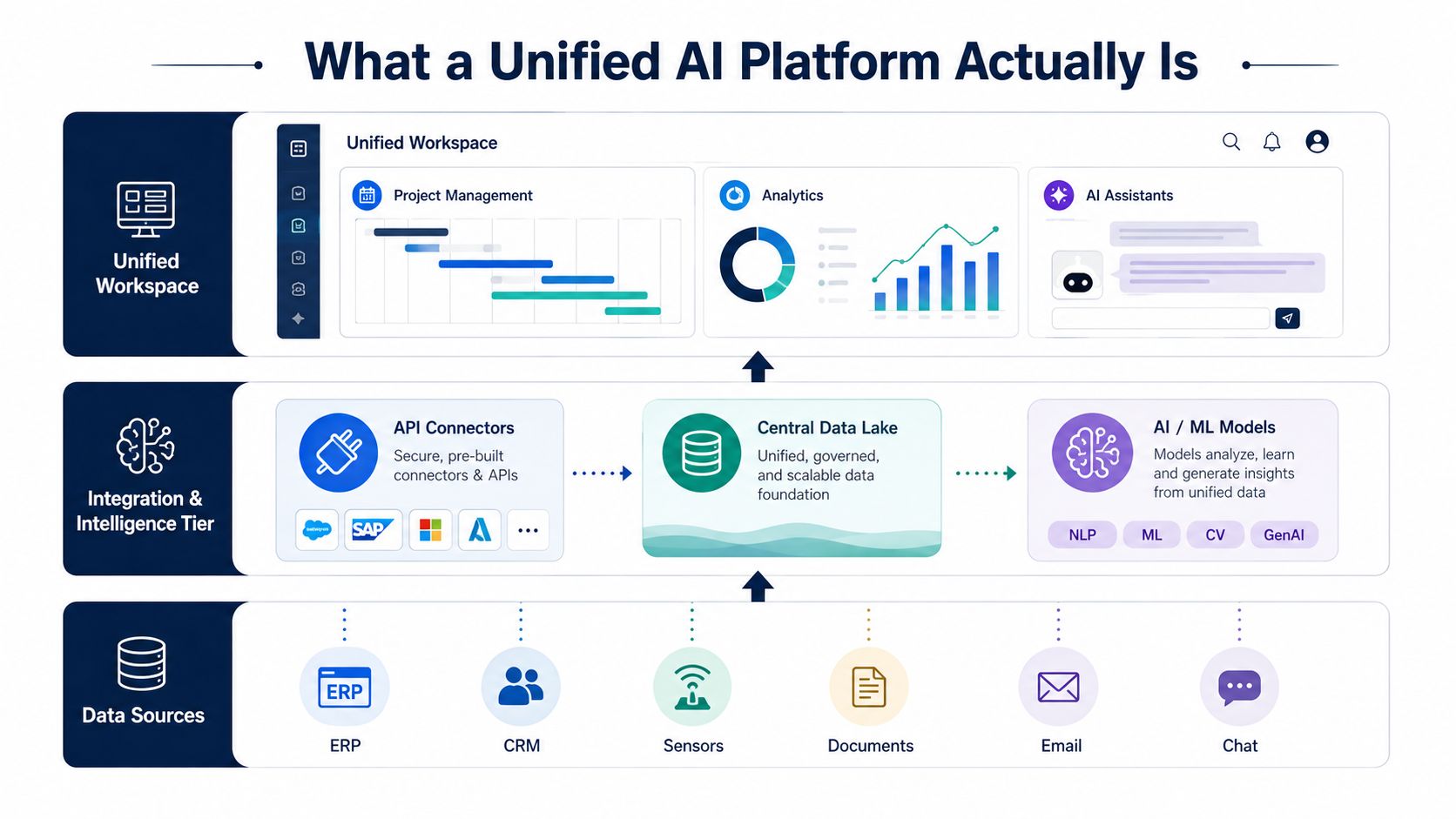
The third layer is governed storage. It gives the business cleaned, versioned data with ownership, access rules, lineage, and retention controls. The platform becomes more than a bundled SaaS suite. If every module still stores an isolated customer record and applies its own policy logic, the interface may look unified while the architecture remains fragmented.
The fourth layer is the model layer. Embedded AI assistants and language models retrieve information from governed business data, rather than treating every prompt as a disconnected question. The fifth is consumption, where people receive results through dashboards, workflows, alerts, summaries, approvals, and voice assistants.
Independent architecture research describes this connected pattern as the core design for unified multi-cloud AI data platforms, while Microsoft's guidance frames a unified data platform as the foundation on which AI agents depend. The practical benefit is straightforward. When transformation rules, access controls, lineage, and quality policies live in the shared data layer, teams don't have to rebuild them inside every application. See this practical guide to intelligent document processing platforms for a useful view of how documents can enter that governed flow.
The test that separates a platform from a bundle
Ask one question during a demonstration: Can the assistant answer from the same live records that drive the workflow, and can it trigger the next approved action?
A genuine platform should connect a sales order to inventory, purchasing, delivery, invoicing, and reporting. A bundle may display those functions side by side but still require exports, duplicate configuration, and manual reconciliation between modules.
Zynthoro follows the platform model through connected areas for finance, sales, project management, HR, communication, marketing, operations, and production. Its production capabilities include recipes, multi-level bills of materials, work orders, quality control, lot traceability, and cost roll-ups. That matters because an AI answer is only as useful as the business process it can safely influence.
Five Engineering Pillars That Make It Work
A unified AI platform succeeds or fails in its engineering details. A clean dashboard can't compensate for broken continuity, vague permissions, or an assistant that can't reach the workflow it describes.
| Pillar | What it really means | Operator verdict |
|---|---|---|
| Data continuity | One governed record survives schema changes, outages, and handoffs | Non-negotiable |
| EU hosting | Residency, GDPR controls, and evidence are built into operations | Non-negotiable |
| Role-based access control | Permissions apply to roles, sensitive fields, sharing, and audit history | Non-negotiable |
| Embedded models | AI reasons over governed business data close to the workflow | Premium |
| Voice assistants | Spoken commands reach approved records and actions | Nice-to-have until field work depends on it |
Data continuity
A single source of truth isn't a slogan about replication. It means finance, sales, operations, and production use consistent identifiers, definitions, and status changes. If a customer changes its billing address in one place but not another, the business still has fragmentation.
The platform should expose data lineage, preserve records through schema changes, and make failed synchronisation visible. Cheap replication isn't continuity if nobody knows which record won or why.
EU hosting and GDPR readiness
EU hosting matters to European SMEs handling employee, customer, financial, or production information. Independent security guidance describes EU or EEA data centres, role-based permissions, and immutable audit trails covering access, uploads, and status changes as practical controls for EU-hosted systems. Zynthoro's EU-hosted, GDPR-ready model fits that operational pattern, but buyers should still verify their own lawful basis, retention, processor agreements, and assessment requirements.
Governance deserves a place in procurement, not a footnote. KPMG's data governance research reports that 62% of organizations see weak data governance as the main data challenge inhibiting AI initiatives. The platform must show who accessed data, which model used it, and what action followed.
Role-based access control
A login wall isn't access control. Finance may need full invoice visibility, sales may need customer and pipeline access, and a production operator may need work-order instructions without seeing payroll.
Look for field-level restrictions, role-based permissions, time-bound external sharing, approval gates, and audit trails. The system should make permissions understandable enough for an SME administrator to maintain without a specialist security team.
Embedded models
AI should run close to the governed data wherever the architecture and risk model allow it. Retrieval over approved documents and records reduces unnecessary copying into separate tools and gives users a clearer basis for reviewing an answer.
Zynthoro describes embedded assistants powered by Anthropic Claude, integrated into workflows rather than added as a detached chatbot. Connected-tool directories such as Donely's integrations are useful for mapping existing connections, but integration breadth isn't the same as governed execution.
Voice assistants
Voice becomes practical when it reaches the same work queue as typed input. A production supervisor should be able to record an update that lands against the correct work order, while a field worker should be able to capture a task without opening a separate dictation app.
Treat voice as a nice-to-have for desk-heavy teams and a premium capability for mobile or production teams. Test accents, noisy environments, confirmation steps, and permission boundaries before relying on it.
Zynthoro also lists Kickstart 1, priced at €79 one-time with lifetime access, AI assistants, 50 credits per month, planning and time tracking, a communication module, and Canva Studio. Those are catalog facts, not a substitute for checking whether the workflows your business needs are included.
Unified AI Platform vs Point Solutions
Point solutions are not automatically bad. They become expensive when each one owns a critical fragment of the same process.
For an SME with one finance lead, one operations manager, and no data engineers, the decision should focus on the work required to keep systems aligned. A specialist tool may deliver exceptional depth, but the business must also maintain connectors, mappings, permissions, exports, and staff training around it.
| Criterion | Unified AI Platform | Point Solutions |
|---|---|---|
| Integration effort | One shared data model can reduce handoffs and duplicate mappings | Each tool needs connectors and process ownership |
| Total cost of ownership | Fewer overlapping systems, but platform pricing and migration require scrutiny | Easier to start narrowly, with costs accumulating across tools |
| Data governance | Central policies and audit controls can apply across workflows | Governance is often split across vendors and admin consoles |
| Onboarding time | Broader initial change, then fewer systems to learn | Smaller first step, followed by cumulative tool training |
| AI feature depth | Strong for cross-functional workflow assistance | Often deeper for a narrow use case |
| Fit for a lean SME team | Better where continuity matters more than niche depth | Better where a specialist capability is business-critical |
The unified option usually wins for repeatable workflows that cross departments. Quote to order, order to purchase, project to invoice, employee request to approval, and batch to quality record all benefit from shared context.
Point tools still deserve a deliberate place in three situations:
- Certified reporting: A regulated filing or statutory process may require a specialist vendor with the required certification.
- Niche industry depth: A highly specialised compliance, laboratory, or engineering workflow may exceed a broad SME platform.
- Best-of-breed creative work: Teams that depend on advanced editing, design, or production tools may keep those applications and connect the approved outputs.
The practical answer isn't blind consolidation. It's a unified core with controlled plug-ins. Use Zynthoro for connected business records and workflow execution, then retain a specialist tool only when its depth clearly justifies the integration and governance burden.
Real SME Scenarios Where One Workspace Wins
A platform earns its place by removing a handoff that people currently repeat every day. The following scenarios show where Zynthoro's connected modules can replace fragmented stacks. The figures are illustrative operating scenarios, not reported customer results.
A creative agency with 12 people
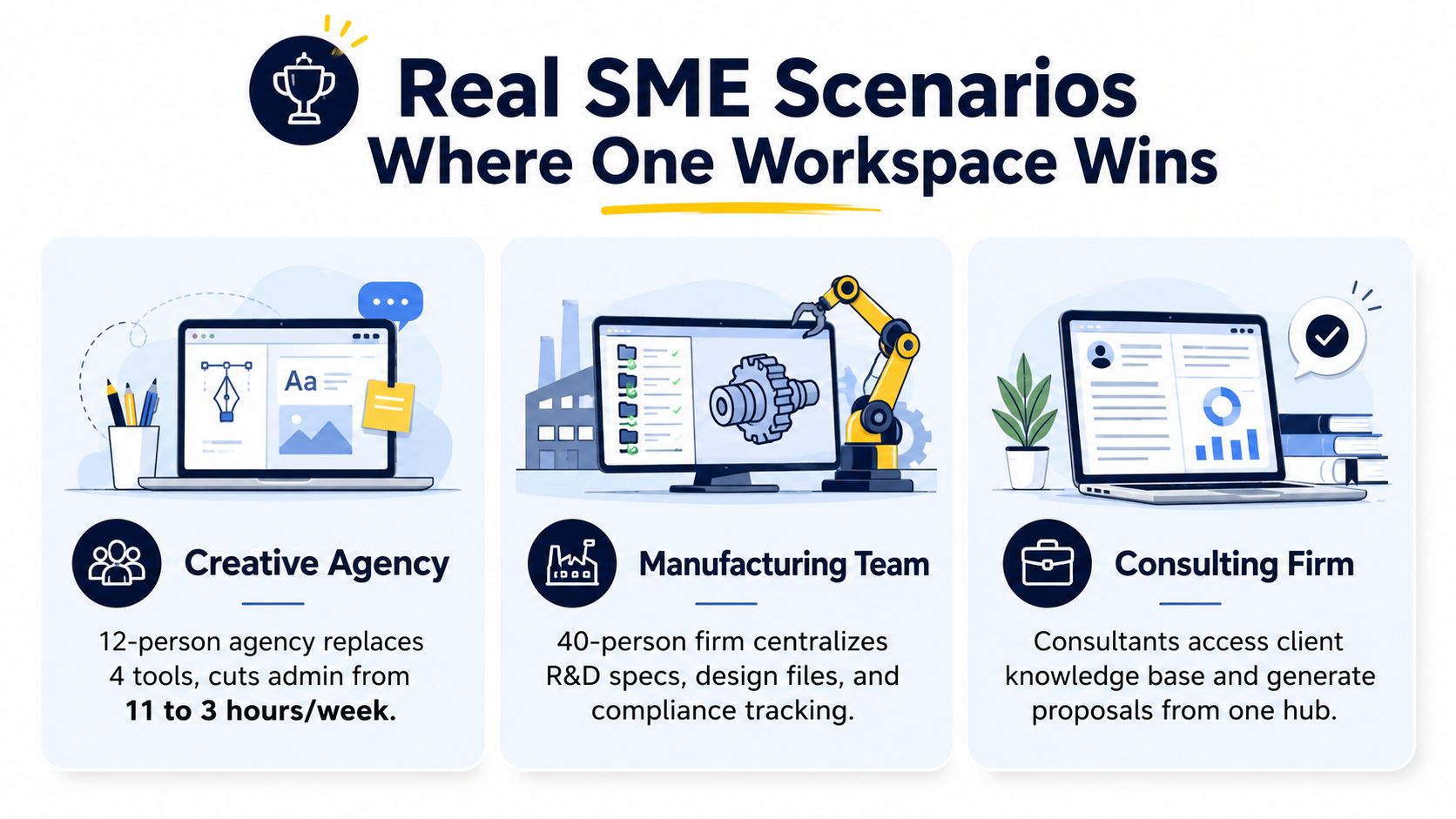
The agency uses separate project management, time tracking, invoicing, and AI copy tools. Account managers copy project status into client emails, the finance lead checks time entries before invoicing, and the owner reviews several systems to understand margin.
Zynthoro's project management, time tracking, invoicing and finance, communication, and marketing and content modules can place those activities in one workspace. A project update can include AI-generated status summaries, tracked time can support billing, and the same client record can connect delivery with finance.
In this illustrative scenario, replacing four tools reduces weekly administration from 11 hours to 3 hours. That is not a guaranteed result. It is the kind of workflow-specific baseline an owner should measure during a pilot.
A precision-parts manufacturer with 40 people
Sales stores quotes in the CRM, production maintains job details in spreadsheets, machine information sits elsewhere, and updates travel through chat. A change in specification can reach the shop floor late, while costing depends on manual spreadsheet handoffs.
A connected setup links quoting, sales administration, purchase administration, inventory, production work orders, quality control, operations monitoring, and communication. Recipes and multi-level BOMs can connect requirements to cost roll-ups, while lot traceability helps the team identify affected production records when quality issues arise.
Traceability isn't theoretical in regulated manufacturing. EUR-Lex's explanation of pre-packaged food traceability defines a food lot as sales units produced, manufactured, or packaged under practically the same conditions, and explains the requirement to label pre-packaged foods so consumers can identify the relevant lot. The same operational logic supports fast isolation in food, cosmetics, pharma, and light manufacturing.
The gain here isn't a promised percentage. It's fewer spreadsheet transfers, faster access to current specifications, and a clearer chain from order to production record.
A consultancy with six people
The consultancy runs its CRM, proposal drafting, contract management, and revenue forecasting separately. The founder knows the pipeline, the finance lead knows the invoices, and month-end depends on reconciling both manually.
Zynthoro's sales administration, communication and collaboration, project management, contracts and personnel workflows, and finance capabilities can keep client activity connected to delivery and billing. An assistant can draft from approved client context, while revenue reporting draws from the same commercial records rather than a manually maintained forecast sheet.
In this illustrative scenario, the team closes month-end books in two days instead of nine. Again, treat that as a pilot target to validate, not a product guarantee.
For a broader package, Kickstarter 3 lists €199 one-time, lifetime access, everything in K2, 300 credits per month, accounting and operations, project management, and marketing and content. Compare those listed capabilities with the actual workflows you need to migrate.
The common thread is not the industry. It's the handoff. One workspace wins when a record created by one person becomes usable by the next person without re-entry, export, or interpretation.
The Hidden Costs of Going All-in-One
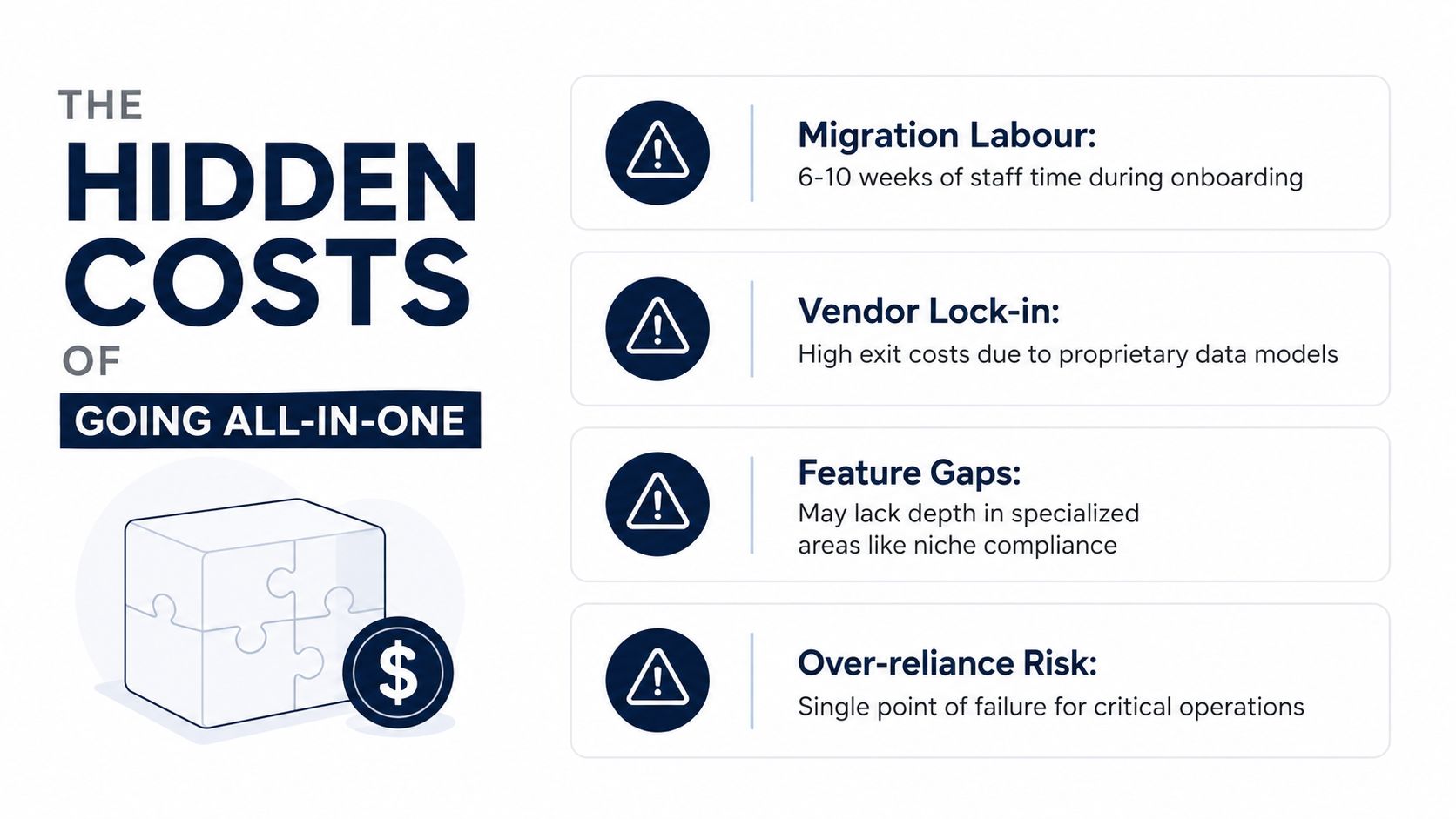
“All-in-one” can reduce tool sprawl, but it can also move complexity into migration, governance, configuration, and commercial dependency. Recent industry coverage warns that unified AI offerings may bundle infrastructure, models, data services, and agents while leaving buyers with unpredictable pricing, implementation work, ongoing optimisation, and lock-in risk. The platform can centralise control without making every operation simple.
Migration labour
Moving accounts, products, contacts, invoices, permissions, documents, and historical records takes staff time. The plan notes for this guide put migration at 6 to 10 weeks of staff time, but that figure must be treated as a planning assumption, not a universal benchmark.
De-risk it with a sandbox trial. Export a representative slice of data, map the fields, test exceptions, and run one complete workflow before committing to a broad cutover.
Vendor lock-in
A proprietary data model can make exit costly. Before signing, ask for export formats, ownership terms, API access, retention rules, and the process for retrieving documents, audit logs, and workflow history.
Put the export path in the contract. A platform that makes it easy to enter but vague to leave deserves scrutiny.
Governance overhead
One admin console still needs an owner. Someone must maintain roles, review audit trails, approve integrations, and control prompt and knowledge-base hygiene.
Name that owner before launch. Define who can approve an AI action, who reviews exceptions, and how the business handles a wrong answer.
Feature gaps
A broad platform may not match the depth of a specialist tool in a narrow lane. Keep the specialist when it supports a critical certified, creative, or industry-specific requirement.
Use a 90-day re-evaluation gate. Measure adoption, workflow completion, data quality, support effort, and export readiness. If the platform hasn't reduced the burden it was bought to remove, change the design or change the tool.
A 30-60-90 Day Plan and ROI Checklist
Start with the workflow, not the feature catalogue. Choose one finance process, one operational process, and one production or delivery process that currently require the most copying and reconciliation.
| Phase | Key actions | Deliverable | ROI metric to track |
|---|---|---|---|
| First 30 days | Audit exports, map records, identify owners, define RBAC roles, select a pilot | Data map, risk register, pilot scope, baseline | Hours spent per role and current error patterns |
| Days 31 to 60 | Configure modules, import controlled data, set approval rules, train users, test assistants and voice commands | Working workflows, trained users, permission matrix | Completed workflows without re-entry |
| Days 61 to 90 | Run live operations, benchmark dashboards, review audit trails, fix exceptions, assess plug-ins | Performance review and expansion decision | Time saved, license consolidation, quality and compliance indicators |
First 30 days
Inventory every export and spreadsheet. Label the owner, update frequency, sensitive fields, and downstream users. Define roles before importing data, especially for finance, HR, customer records, and production quality information.
Choose a narrow pilot with a visible handoff. Quote to invoice is often easier to evaluate than a vague “AI transformation” project because the starting and ending records are clear.
Days 31 to 60
Configure the shared records first, then add assistants. Train users on the new workflow, not just on menus. Test rejected approvals, missing data, duplicate contacts, permission boundaries, and an incorrect AI suggestion.
For Zynthoro, evaluate whether finance, invoicing, sales, project management, operations, communication, and production records connect in the way your business works. Don't accept a polished demo as proof of continuity.
Days 61 to 90
Track the baseline against live use. Count hours saved by role, manual entries removed, errors corrected, invoices reconciled, approval delays, and support requests. Review audit trails and ask users where they still leave the platform for specialist work.
Your ROI checklist should include:
- Labour: Hours saved for finance, operations, sales, and delivery.
- Quality: Duplicate records, correction work, failed handoffs, and stale reports.
- Commercial: Licences retired, migration effort, training effort, and ongoing administration.
- Compliance: Access evidence, audit coverage, residency requirements, and approval history.
- Adoption: Active users, completed workflows, assistant usage, and retained specialist tools.
The strongest business case isn't “AI can do everything.” It's that a defined workflow moves from event to decision to approved action with fewer people acting as human connectors.
Zynthoro brings finance, operations, sales, collaboration, production, embedded AI assistants, voice input, GDPR-ready controls, and EU hosting into one SME workspace. Visit Zynthoro to review whether it can absorb your highest-cost handoffs without replacing a necessary specialist tool.